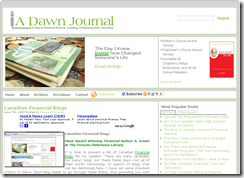
Is A Dawn Journal The Best Personal Finance Blog?

Is A Dawn Journal The Top Personal Finance Blog?

First Published: ADawnJournal.com May 4, 2010

Is it possible to rank a personal finance blog or website “The Best” based on its traffic or content? I don’t know how many personal finance blogs exist today on the Internet; however, I do know that there are roughly 130 million blogs live these days and this number will only grow in the future. Among the total number of blogs, even if only a few percentages are personal finance blogs, that makes the total number of financial blogs a significant big number. And claiming one particular blog, such as A Dawn Journal to be “The Best Personal Finance Blog or Website” or “The Top Personal Finance Blog or website” would be preposterous. However, I would not hesitate to claim A Dawn Journal to be a very “different kind of personal finance blog or website” and I can claim that with confidence.

Here are some facts that make ADJ fairly distinguishable from its peers, different from any other financial blogs. Let’s go over some of these facts:

o You will come across many personal finance blogs these days; however, you will hardly come across situations in which the authors of these blogs have both education and work- related financial background. I come from both an educational and work-related strong financial background. My extensive education, training and experience have enabled me to develop the knowledge and skills required to write this and many other blogs.

o Most other financial sites have something in common – they are for professional investors; hardly will you find a personal finance blog which is easy to absorb and written in clear and simple English for regular and simple readers who are trying to enhance personal finance knowledge to build a secure financial future – just like you.

o Repetition of subjects is what you will find in many other personal finance blogs. How many times you can read articles in same subjects over and over? Do you really want to hold an MBA on TFSA account, discount brokerage ratings, ins and outs of smith maneuvering, how to do wash trading in your brokerage account and so on?

o I try to balance articles on ADJ on a variety of topics ranging across a wide array of subjects. You will come across articles from different viewpoints and every walk of life. The reason I do this? I would like to keep you informed and entertained without boring you and keeping things simple.

o I am one of the few financial bloggers who is also a Financial Author, an Internet Entrepreneur, and a full time Analyst at a Canadian Wealth Management Corp. trying to achieve my goal of living a Dot Com Lifestyle. My interest varies on a broad range of topics from International Real Estate to Green Living. I own lots of domains and many websites. At the end of this post, I will give you a list of my sites for which I write and update manually by myself.

After considering all the facts I presented above, it is up to you to see A Dawn Journal as the best or top personal finance blog or website, a different financial blog, or the worst personal finance blog ever. Regardless of what you think of ADJ, I appreciate your time for reading A Dawn Journal and hope to see you again.

How To Manage A Mortgage

Managing A Mortgage To Your Advantage

If you are looking for a worthwhile mortgage in today’s market, it is advisable to be ready for some difficult years ahead, as the real estate market searches for stability in the wake of two years of severe turmoil. Mortgage management is more important now than it has ever been before, as there is a tendency among banks to become very nervous and panicky when customers exhibit any sign of the feckless borrowing habits that played such a large part in triggering the current global financial crisis. It is not necessarily more likely that you will be the victim of a repossession – banks are still reluctant to do this where there is any other option – but it will affect what kind of deal you can get, if you happen to be caught up in a situation where you are unable to pay.

Mortgage management begins right at the start of the mortgage period, when you first apply for the loan. The first part of a good process of mortgage management is to tell the truth on your application. There are some situations where it is possible to successfully apply for a mortgage by lying on your application and qualifying for preferential rates. Depending on the level of due diligence carried out by the lending bank, you may get away with it. If you do, however, it is important to remember that mortgage loans are frequently renegotiated, and that any information you give on your application can be checked at the source. If you lied on your initial application it is an option for the bank to sue you.

Another reason why it is simply common sense to tell the truth on your application is that although the lie may give you a preferential rate, you may still find it difficult to make the monthly payments on a big loan. If you struggle with these payments, you may be asked to provide evidence for why this has happened, and if you expose the lie at that point you are again liable to be sued.

By far and away the main aspects of sound mortgage management come, though, when you have been awarded the mortgage and are paying monthly to the account. Budgeting plays a huge part in mortgage management, and making sure that the first deduction you make from any month’s pay check is your mortgage payment should mean that you can prioritize your financial commitments – of which keeping a roof over your head must be considered the most important.

If you ever fall into financial difficulties that make the monthly payments to your mortgage difficult to maintain, it is essential that you discuss the matter with your mortgage lender. Early reporting of any problems makes for a much better chance of solving them than late reporting.

Finally, and quite literally so, if you find yourself in with a chance of paying off your mortgage in full you should take into account what the most economic way of doing this will be. Some lenders charge a surcharge for early payment, although this can be on a sliding scale and may also be negotiable. Check your terms and conditions, and discuss matters with your lender.

How to Teach Kids About Money

Teaching Children About Personal Finances

First Published: ADawnJournal.com February 16, 2010

When it comes to teaching children about money and personal finances, we all seem to tumble and often it seems like a taboo. Here are some ideas that will help you teach your kids how to become financially responsible and successful in their adult lives.

You should start teaching your children the value of money at a young age. Explain to them the difference between needs and wants and tell them that money does not grow on trees. Money comes from hard work and each of us has responsibilities to our family, community, and the world.

Do not pay kids a straight allowance without guiding them towards what to do with it properly. When you give them an allowance, break it down into categories such as 10% or 15% should go to their savings account, and what other percentages that should be spent to pay for their books, activities, lunch, and so on.

Do not pay kids to do regular household chores that they would normally do. Explain to them what regular chores they are required to do and what chores can be considered special projects they can get paid for – if they are able to complete it successfully. These chores are outside regular ones and you would hire someone else to do it normally. Examples are: mowing the lawn, cleaning the backyard, and so on.

Once kids have a fair idea of what money is, start teaching them how a bank works, what a credit card is and why it charges interest, what a budget is and why it is important. The age range to discuss this would be 7 – 10.

Once kids start earning money, ask them to save 15 – 20 %. Explain to them that it is very important to spend less than what they earn and to save 15 – 20% continuously as they continue working into their adulthood. If they can follow this simple rule, they will be very rich one day.

It’s a very good idea to encourage kids to pursue entrepreneurial and marketable skills. Discuss with your kids what it means to be an entrepreneur and encourage them to use their creativity to find money making ideas or to open a business kids can operate in the surrounding neighbourhoods. Also, explain to them how some skills can pay off for their lifetime and it is worth learning these skills at an early age. Examples are: writing stories, setting up online blog and make money from it, learning graphics designing, learning how to repair a bike, learning how to paint, how to fix a computer, and so on. Don’t pressure kids to learn what you think will be in demand; rather, let them find the stuff they are interested in and wanting to learn.

Explain to your kids that education is very important. Even if they start making tons of money with their business or entrepreneurial skills, it is important to have a 4-year degree. Encourage them to pay their tuition with their own money – as much as possible. This will make them understand the value of each dollar and will teach them to appreciate what they have.

Giving is very important. Teach kids the joy of giving. Explain to them that we live on a small planet called “Earth” and not everyone is as fortunate as we are. We all can help those who need it most by donating, participating in voluntary works, helping charity organizations, and opening ourselves to build a better world.

Teaching kids about money is one of the best things you can ever give to your kids. It will build a solid financial roadmap for them to follow and will help them to secure a better financial future for their lifetime.

Mortgage Insurance-Always Read The Small Print

Mortgage Insurance Terms and Conditions

First Published: ADawnJournal.com February 28, 2010

Borrowing to pay for a house is something that can raise the hairs on the back of anyone’s neck. With a likely 25+ years’ term on the loan, there is plenty of scope for anything to go wrong and for the mortgage to end up posing you some real problems. Yet people keep doing it because, short of having substantial savings or a large windfall, there is no other way for most of us to own our own home – even if it belongs at least partly to the bank for the first quarter of a century. At the point where the mortgage is paid off in full, that house is 100% yours – something which a lot of people consider one of their proudest moments.

The twenty five years (or more) between taking out the loan and paying it off, though, is undoubtedly a long time. In that time any number of things can happen, which is why most mortgages come with an insurance package on top of the other options. Insurance works the same on a mortgage as it does with most other personal insurance packages. If death, illness or unemployment leave you struggling to pay off the mortgage, the insurance is there for the purposes of paying off the loan (or meeting monthly payments for a period) and freeing you from the financial burden on top of an already undesirable situation. Depending on the nature of the insurance and the contents of the terms and conditions, you could find that the mortgage is a god-send. The key matter as far as this goes is liability.

There are probably no insurance packages available in the world today that do not come with a list of terms and conditions that apply caveats to the insurance you are offered. If you claim on the insurance, it will pay out on the condition that none of the “small print” terms and conditions are violated. Your insurance package is likely to pay out if you can prove that you could not reasonably have foreseen the set of circumstances that necessitate the claim, and that it wasn’t your fault. In case of death, the insurance company may well ask for a medical report. Cases of suicide, or death from a long standing condition that the mortgage holder kept to themselves, can invalidate the insurance.

If health problems make it difficult or impossible for you to bring in enough money to meet the mortgage payments, it is possible that the insurance will come to your aid. Again, though, it is essential that you read the small print because if you suffered from this condition before you took out the insurance, the policy will not pay out in most cases.

Unemployment is another common reason for claiming on mortgage insurance, but this is perhaps the most laden with stipulations. Did you resign from your job? Insurance won’t cover you. Did you get fired for performance reasons? No cover there either. Were you sacked as a result of participation in industrial action? You’re not covered. The list of reasons for unemployment which actually do qualify is shorter than those which do not. If the insurance company judges you to be liable for the situation that has left you in this mess, they will not pay.

What Is Asset Allocation?

Asset Allocation, Diversification, and Your Portfolio

First Published: ADawnJournal.com March 3, 2010

Asset allocation is an investment strategy which simply entails allocating your assets (your investment portfolio) among different categories of investments, such as stocks, bonds, money market funds, cash etc. Asset allocation helps to minimize risks and maximize gains because it diversifies your portfolio among various types of investment or investment products instead of keeping them in one place.

What Types of Asset Allocation Will Work Best For Me?

Although there are many rules of thumb regarding asset allocation, no one can tell you exactly which one is right or which one is wrong for you – as this is a very personal matter which largely depends on various factors as described below:

·   Time Horizon: Time horizon is how much time you have ahead of you to invest in reaching your financial goals. An investor with a longer time horizon has time on his side and will be able to choose volatile or riskier products for maximum returns – because if markets go down, this investor can wait to ride out the volatility. On the other hand, an investor with shorter time horizon will not be able to afford risky product, as he will not have the luxury to wait for the market to go up if he falls into financial meltdown.

·   Risk Tolerance: Risk tolerance is your ability to take risks for better returns. In the investment world, risk and reward are inextricably entwined. If you are young (like in your 20s or 30s), you may not care that much about losing 35% of your value, as you know you have a long way to go. But when you are in your 40s or 50s, with kids’ education and retirement in mind, a 20% drop in your portfolio may be enough to lose sleep at night.

·   Investing Is An Ongoing Learning Process: In my book Invest Now, I have mentioned that investment is nothing but a discipline, and it has to be orchestrated with great passion and care. Investment is not like going to the shopping mall and buying a few things impulsively – it is a lifelong learning process. Asset allocation or any other investment ideas are not set in stone and these will change as time changes. Always upgrade yourself with financial changes in the broad global perspective and you will have to change your investment strategies to bridge the gap between the present and the future.

·   Individuality Counts: Although you will find there are many rules of thumb or pre-made portfolios when it comes to asset allocation, there is no single allocation or portfolio available that will be right for everyone. Everyone is different and so should be their asset allocation. The onus is on you to find out the best asset allocation that suits your needs.

What Are Some Major Asset Categories?

These days, a wide array of investment products exist to give you a wide range of asset allocation with a broad diversification. However, there are only three major asset categories I will mention here:

·   Equities or Stocks: The word “stock” is interchangeable with “share,” “equity,” “security” and so on. Stocks represent ownership in a company and historically offer the greatest risk and highest returns among other asset groups mentioned here. Stocks should not be used as a short term investment as it can be very volatile to hold for a short period of time.

·   Fixed Income Investments or Bonds: Some other fixed income investment products are government savings bonds, bond mutual funds, etc. These types of products are less volatile than equities and offer modest returns as well. Fixed income products can offer steady flow of income – depending on its objective.

·   Cash Equivalents or Cash: This can be plain cash or products like savings accounts, money market funds, treasury bills, etc. These are considered the safest investments with minimal returns with almost no risks.

Why Asset Allocation Works?

Due to economic and market conditions, no one can predict the best performing assets and it varies year to year. Time has proved that during bad and good economic times, all asset classes do not move in the same direction. By diversifying your assets among various categories, you are minimizing your risks. If one asset class goes down, the other asset class is there to protect you by averaging out. Also, to reach your financial goals, you need to balance your portfolio by keeping both high-return and low-return investment products. If you keep only one type of product in your portfolio, you may never be able to reach your investment objectives – as it will be either too risky or too safe. Asset allocation helps you to diversify and balance your portfolio.

What Are Some Common Asset Allocation Rules of Thumb?

There are so many rules of thumb on this topic that it can be overwhelming. Many consider a neutral asset allocation should be 60% stocks and 40% bonds. Another rule of thumb goes like: subtract your age from 100 and you will get the percentage to hold in stocks. For example, if you are 40, 100-40 = 60% of your portfolio should be in stocks and 40% should be in bonds.

Is Diversification Same As Asset Allocation?

The old saying “Don’t put all your eggs in one basket” was good advice 100 years ago, and it will be good advice forever. Whether you are a first-time or a veteran investor, you always need to spread out your investments to minimize your risks. Diversification refers to the process of spreading investments among various equities. Asset allocation refers to the process of spreading investments beyond multiple equities and over several asset classes such equities, bonds, cash, etc.

Asset Allocation is a diversification strategy that helps you to offset decline in any particular asset classes by gains in other asset classes – thus reducing the fluctuations of performance of a portfolio. It is unlikely that all asset classes will go downhill at the same time.

Do You Have Your Own Asset Allocation Model Portfolio?

Yes, to make investing simple and worry-free, I have invented a model portfolio called “A Dawn Timeless Portfolio” or simply ADTP. You can read more about ADTP here – (I am still working on this project and will add a link once done)

To find many other online asset allocation calculators, do a search by entering these keyword phrases: “asset allocation calculators,” “portfolio asset allocations tools,” etc.

Last Word

Model portfolios and asset allocation tools are to help you understand asset allocation. Do not blindly follow any model portfolios or tools just because it looks cool. You are different than anyone else – make an educated decision based on your time horizon, risk tolerance, financial goals, and your overall financial situation.