Canadian Bankruptcy

Filing Bankruptcy In Canada

First Published Date: March 14, 2009

Sometimes, no matter how much one wants to prevent it, personal finances can spiral out of control. You can find yourself struggling to make debt repayments, worrying constantly about the future and what it may bring. If you ever reach the stage where you freeze in terror every time the phone rings or the doorbell goes, it may be time to face the state of your finances.

When it comes to personal debt, the word bankruptcy is particularly terrifying. To many, it signals the end of life as they know it, and as well as the financial implications there is something of a social stigma attached to it. Yet sometimes, if debts are substantial and you aren’t earning enough money to cover your outgoings, it is the only reasonable option to free yourself from the never ending cycle of debt. Bankruptcy is the last resort and should only be entered in to with the knowledge that all else has failed, but it’s part in helping resolve finance issues is irreplaceable.

In 2007, more than 100,000 Canadian nationals filed for bankruptcy, so you are not alone. If you have decided bankruptcy is the only option left available to you, you begin the process by filing for bankruptcy via a trustee for bankruptcy. To find one, check your provincial advice pages or even just check the Yellow Pages.

When you file for bankruptcy, an automatic stay is granted to you. This means that, during the bankruptcy process, your creditors cannot make moves to seize assets and should stop making collections calls.

For a first time bankrupt, the term of the bankruptcy is nine months. This increases if you have to go bankrupt more than once. At the end of the nine months, the bankruptcy is discharged. During those nine months, you are required to make payments to your creditors and to the trustee you petitioned for bankruptcy with. Depending on the size of debt, these payments vary, with a national standard of $200 per month for the nine months. You will also need to pay around $85 for financial counselling as a condition of discharge. At the end of the nine-month period, the bankruptcy is discharged and in all but a few rare cases the debts are erased.

Bankruptcy does not automatically mean you will lose all your asset s, as in most cases there are certain limits that you can own. For example, In Ontario, you can keep up to $5,650 equity in a vehicle, $11,300 worth of household goods, and up to a value of $11,300.00 worth tools you use to earn your living . Your trustee, who will advise the best course of action, which may involve selling items, makes the decision on any amounts over these for each particular area.

When discharged, the bankruptcy will remain on your credit file for up to six years. During this period, it may be difficult – though not impossible – to get credit. However, this should not be too much of a deterrent; as if you are in a situation where bankruptcy is the only option; your credit file is going to be damaged hugely anyway. At least with bankruptcy you gain a clean slate in six years, something that would be hard to do struggling to make repayments on any large debts.

Overall, if you have reached the end of the line and creditors are hassling you non-stop, bankruptcy may be the most efficient and effective method of getting out of trouble. If you are having difficulty paying your debts and/or considering bankruptcy, I suggest you contact a Canadian Bankruptcy Trustee licensed by the federal government to discuss your situation. To find a trustee in your area, search on Google or Yahoo using these keywords: Bankruptcy, Trustees, Your Area.

To streamline and minimize blog maintenance, I will be discontinuing maintaining the Canadapersonalfinancewebsite.com website (however, I will still hold the domain). I will gradually move all articles from this site to A Dawn Journal. This article originally published on the above website on Mar 14, 2009.

Money Saving Tips

Simple Ways To Save Money

First Published Date: Dec 8, 2008

Today, I will discuss how you can save money by taking these simple steps. Let’s look at five areas we spend money on a daily basis. 

Save Money On Cable TV

Cable TV can cost you from $50 to $100 per month – which translates approximately $600 to $1200 annually. These amount are hard cash you are paying with your after-tax money. If you think in terms of before-tax income, you will be saving a lot of money. Living without cable is not impossible. Many people watch broadcast channels, which are free and you can do it too. If you think this is not something you can do, switch from premium cable to basic cable – which will cut your cost in half. Do you really need to have 1000 channels that you hardly watch?

Save Money On Lunch

How much does lunch cost these days? It costs somewhere between $7 to $12 to have a decent lunch. Let’s assume you are spending $10 per day. How much money you are spending annually? $2,400 each year and this is your after-tax money. What it means that if you can eliminate buying lunch all together, you can give yourself a raise of about $4,000 (if you are in a 42% tax bracket) annually. If you can’t cut lunch daily, at least bring lunch from home three or two times a day and still you will be saving a lot of money.

Save Money On Home Phone

We subscribe to lots of features we never use. Cut all these features and live with a basic phone service. You  may be able cut your cost by about 40%. Keep an eye for other phone company offers and rewards. If they are giving the same services you have at lower costs, switch your phone company. Also, you can ask your existing phone company that their competitor is offering it at much lower prices and ask for discounts. Chances are high that you will get it.

Save Money On Cell Phone

Added features on a monthly plan can cost you a bundle. Try to stick to a basic plan that meet your needs. Pay As You Go is an option you should be looking at. Usually it costs a lot less except some extra features. One thing I like about Pay As You Go is that there is no System Access fee. Also, Pay As You Go already includes features like caller id, voice mail etc for free. Nowadays, you can buy unlimited evenings and weekends Pay As You Go services without breaking your bank account.

Save Money On Internet Phone

VOIP (Voice Over Internet Protocol) gives you the opportunity to use your high speed Internet to make phone calls and save money. Home phone plans using VOIP can be as low as $10 per month. Many VOIP companies offer this type of services. To find one, just do an online search entering VOIP, Internet phone keywords. You can even make long distance calls for free these days. Here is an article which explains how to do it –

How To Make Free North American Long Distance Calls

Save Money On Internet Subscription

If you degrade your Internet subscription to a lighter version, you will be able to save 20% to 35% right away. Most likely you will not even notice that you are using a lighter version. This is huge saving as this is a recurring cost you are saving each month, month after month. Another way you can save by switching a no brand name Internet provider. Small Internet providers can offer better rates and savings than brand name ones. You need to do your homework to find one. Just do an online search by entering "Internet service provider" and look for better rates.

Save Money On Magazine Subscriptions

Do you really need to subscribe (or buy) all those magazines which you never have time to read? Most of the magazine publishers put  these magazine contents online for free after a few weeks. You just need to be patient  to save money sometimes.

After reading these tips, start following them to save money. You may not be able to follow each of these but at least try a couple of them and see where it takes you.

To streamline and minimize blog maintenance, I will be discontinuing maintaining the Canadapersonalfinancewebsite.com website (however, I will still hold the domain). I will gradually move all articles from this site to A Dawn Journal. This article originally published on the above website on Dec 8, 2008.

Money Hacks Sample Covers

Money Hacks Cover 1.jpg

One Money Hacks Cover Will Be Final Among Four Covers

First Published Date: November 22, 2014

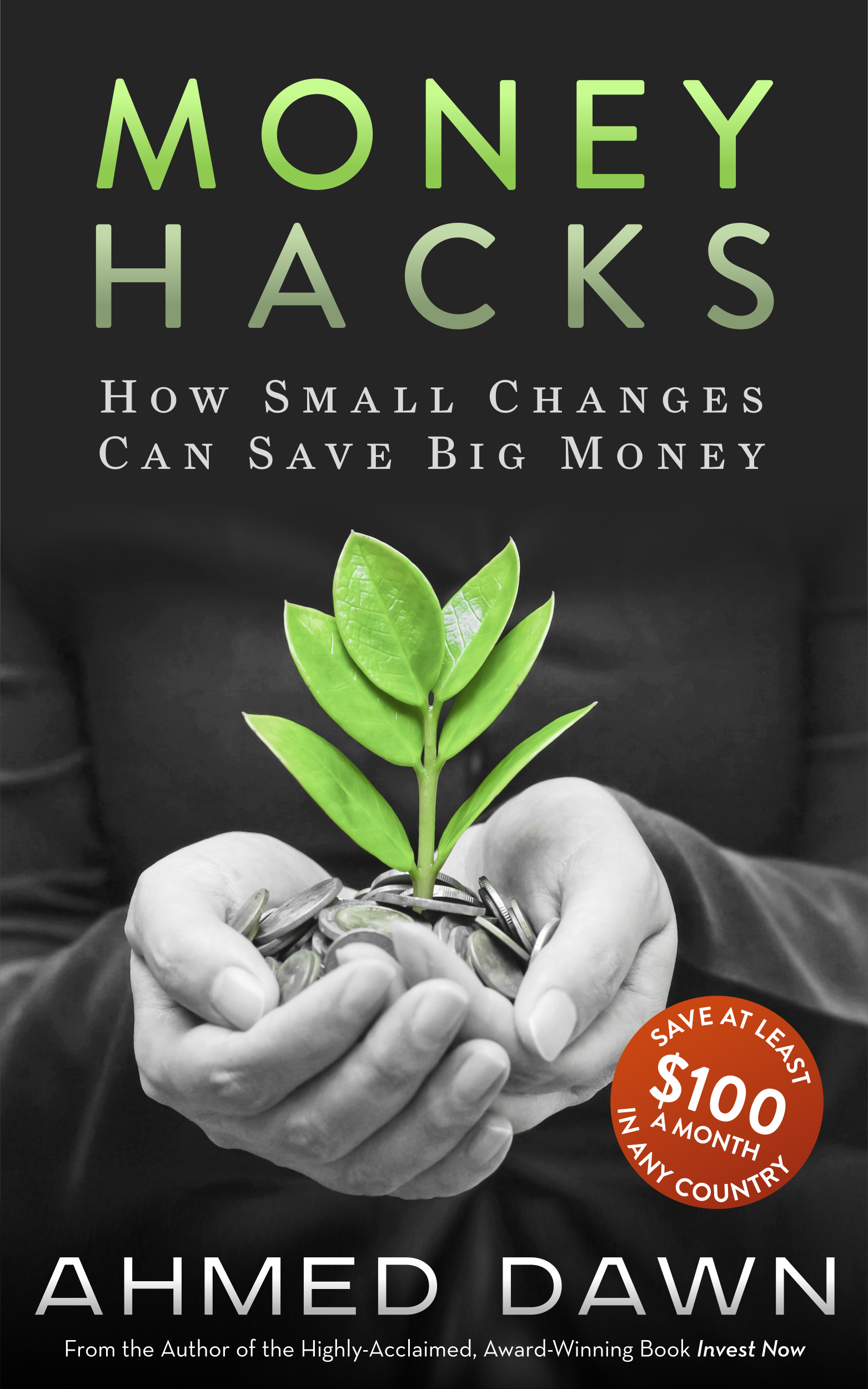
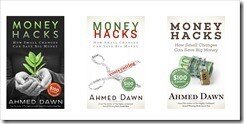
My next eBook Money Hacks: How Small Changes Can Save Big Money is currently going through its cover designing. Cover designers will make four different covers and one of them will be finalized.

Today, I am presenting the first cover that is available as of this moment for my readers. I will try to post the other 3 covers as well to let everyone have a glimpse of how each cover would look like.

On a separate note, the format designer completed formatting the book from Word to Amazon compatible Mobi format. So you can say that the major work is done on the book. The only wait now is to get 3 more covers from a different cover designer and picking the best cover that suits the book.

Money Hacks Cover 2.jpg

I am looking at late November or early December when Money Hacks will be published. So in about 3 more weeks the wait will be over.

NB – After writing this, another 3 covers became available and I am also attaching it here.

Money Hacks: How Small Changes Can Save Big Money Has Been Published

Walk Into Stores With Confidence

First Published Date: November 25, 2014

Buy Money Hacks: How Small Changes Can Save Big Money

I am writing this post to let you all know that my second book Money Hacks has been published and is available to download on Amazon. Unlike my first paperback book Invest Now, which is available at physical bookstores and at all online bookstores, Money Hacks will be available only as an eBook. Money Hacks is a part of Amazon KDP Select program and available exclusively through Amazon Kindle.

Money Hacks delivers surprisingly simple steps to save money. By following practical steps to save money through various walks of life mentioned in Money Hacks, you should be able to save at least $100 monthly anywhere on earth, as Money Hacks has been designed for global readers.

Money Hacks will be available for free for 5 days (starting coming weekend) and you can download from the link mentioned here. However, to make it affordable for everyone I have priced it at only $2.99. So if you miss the free time frame, you can still buy it without breaking the bank.

As there will be several press releases and posts in the coming days, I will keep you posted on A Dawn Journal. I thank all my readers for their support.

Limited Time Opportunity: Download Money Hacks For Free on Amazon

Money Hacks: How Small Changes Can Save Big Money

First Published Date: November 29, 2014

Get Money Hacks For Free For 5 Days Only – Really, No Catch

Today, I am writing this post to let all my readers know that I have started a special promotion for 5 days, so all of my readers get an opportunity to obtain Money Hacks: How Small Changes Can Save Big Money for free. Download Money Hacks for free on your Kindle app (Kindle app is a free application you will have to install on your computer, tablet, or smart phone) and also let your friends and family know, so they can get it for free as well. After all, who does like to save money? Applying the techniques mentioned in Money Hacks will save you at least $100 in any country.

There is no catch or obligation. However, if you decide to show me your support, please write a review or comment on Amazon by following the link. Even a one to two sentence comment can help and it takes less than 5 minutes to do so. You are free to rate any stars from one to five as you feel is appropriate.

Media outlets have been notified via press releases and I will keep you posted on any developments. I am including a pre-release link/attachment/content as an FYI. Thank you for getting a Money Hacks copy and I appreciate your support.