CIBC Air Canada Card Was Compromised

CIBC AC Conversion Visa Prepaid Card

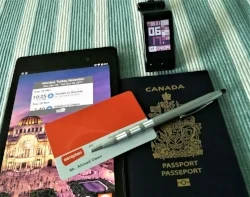
About 2 weeks ago, I found out that my CIBC AC Prepaid Visa card was compromised. However, this card was never stolen or lost.

When trying to load my card online, I noticed scammers made 9 fraudulent transactions. The small transactions were made via PayPal and 2 large transactions were made from Malaysia. One of these was Expedia Malaysia and the other one was an airfare purchase from Malaysia.

CIBC is not the back office for this card. A third party prepaid credit card provider I2C (http://www.i2cinc.com/) in California is the back office and provides support maintaining this card and they don’t take calls, so I had to talk to CIBC customer service and file a complaint form. I was told that it could take up to 40 days to complete the investigation and reverse those charges.

The reason I use this card is because I can control how much credit availability the card can have and it’s especially handy when you are travelling. So scammers were able to extract only around $200 due to low availability.

What surprised me most is that I2C’s fraud detection system totally failed, as there were 9 transactions and they raised no flags whatsoever. In the past, I dealt with fraudulent activities on my credit cards and their systems flagged and blocked my cards after 1 or 2 transactions. After 9 transactions, my AC Conversion card had no more balance left for the scammers to take out and that’s why it stopped. No fraud detection system stopped it.

I will link a video I made on this on the top left and here: My Travel Visa Card Was Compromised. I will give some tips to help you protect yourself from credit card scams in that video as well.

Meridian Visa Infinite Travel Rewards Card: Should You Keep It?

Meridian Visa Infinite Travel Rewards Card Review

The Meridian Visa Infinite Travel Rewards Card is a travel rewards credit card that lets you earn rewards points for everyday purchases that can be used for travel, merchandise, gift cards, or special events.

The Cost

Annual Fee = $99 (First year free). Additional cards = $30

Minimum annual income required = $60,000 (personal) or $100,000 (household)

Rewards Points Snapshot

– Earn 1.5 points for every $1 spent in all credit card purchases

- Earn 3 points for every $1 spent in foreign currencies

– No caps, no tiers, no restrictions

First Time Bonus

None

Anniversary Bonus

None

Features & Benefits

– Complimentary 24/7 Visa Infinite Concierge.

– Emergency Medical Insurance (48 days<59, 23 days=60–64, 15 days=65-75, None>76, Amount: 5 M/per person).

– Travel Accident Insurance (up to $1,000,000 CAD, No age limit).

– Auto Rental Theft and Collision/Loss Damage Insurance (Up to 48 days)

– Trip Cancellation Insurance ($2,000 each).

– Trip Interruption Insurance (Unlimited).

– Flight Delay Insurance (Not clear – No mention of after how many hours, Looks like $2,000, but please call Meridian to confirm).

– Lost and Delayed Luggage (Not clear - No mention of after how many hours, Looks like $500-$1,000, but please call Meridian to confirm).

– Extended Warranty Insurance (1 additional year, $50,000 lifetime limit).

– Purchase Security (90 days, $50,000 lifetime limit).

– Price Protection Insurance (60 days, $100 per item, $500 per year limit)

– Mobile Device Insurance (Up to $1,000)

What’s Missing

– Hotel/Motel Burglary Insurance

Meridian Visa Infinite Travel Rewards Card - My Take

The Meridian Visa Infinite Travel Rewards Card is a new entrant on the Canadian credit card market. The rewards points earning rate is not that great because it generates only 1.5 percent return on everyday purchases. However, the 3 percent return on foreign purchases would offset the 2.5 percent foreign transaction fees and there will still be a half percent return. Most Canadian cards charge foreign transaction fees. If you want to know which cards do not charge foreign fees, watch my video on that.

The interesting twist this card has is its insurance. It offers rich travel insurance for a $99 annual fee. Also, the Emergency Medical Insurance offers longer coverage than most other Canadian travel credit cards (and a higher amount, up to $5 million) for up to 75 years old.

If you pay careful attention to insurance providers, there are two providers working together here. For travel related insurances such as emergency medical, trip interruption, trip cancellation, baggage delay, etc., the provider is Desjardins Financial Security Life Assurance Company. For other segments of insurance such as auto rental, mobile device, purchase + price protection, extended warranty, etc., the provider is American Bankers Insurance Company of Florida (ABIC).

Whichever travel credit cards you use (such as Scotia Gold Amex, Capital One Aspire Travel World Elite MasterCard, and many other Canadian cards), travel insurances are provided by American Bankers Insurance Company of Florida. I would stay away from these, as there are numerous complaints and bad reviews online about these providers when it actually comes to processing claims. So, for the travel insurance elements, the provider is Desjardins and not ABIC, which is a good thing.

Now, it all comes up to your decision making if you are comfortable trusting Desjardins as your insurance provider. Of course, I am assuming they are better than ABIC, but I am not too familiar with Desjardins when it comes to processing claims. You don’t want to take chances paying out of pocket for, let’s say, a $500,000 bill should you require an airlift from a foreign country to Canada and your provider is finding causes to decline your claims.

To wrap it up, Meridian Visa Infinite Travel Rewards Card should not be your primary card to maximize rewards/points earning (except foreign transactions). But it can be a good card for travel insurances if you are fine with Desjardins being the travel insurance provider. Always do your research and make an educated decision.

As of this writing, I do not hold this card.


Why is American Express Canada Removing Their Minimum Income Requirement?

Amex Canada Eliminates Minimum Income

Disclosure: Opinions expressed here are my own and not anyone else’s or those of the credit card companies. My opinions are based on my own analysis and in reality credit card companies may be pursuing these policies and procedures to achieve very different objectives.

American Express recently removed the minimum income requirement on all their cards, including high-end cards such as Amex Gold and Amex Platinum. Today, I will give my take on the reasons behind this decision and what it means for Visa and MasterCard.

Currently Visa’s elite series card, Visa Infinite, has a minimum annual income requirement of $60,000/00 personal and $100,000/00 household and MasterCard’s elite series card, World Elite, has a minimum income requirement of $80,000/00 personal and $150,000/00 household income. By establishing a higher minimum income requirement, Visa and MasterCard don’t want everyone or those with lower income to hold these elite series cards.

This is my understanding that the reasons behind this: merchants pay higher fees on elite series cards and by restricting these cards to only higher income groups Visa and MasterCard are trying to balance out the higher fees merchants pay because it is expected these groups will spend more than lower-income groups. However, in reality this may not be the case, as it is not necessarily true that high-end cardholders will spend more than regular card holders.


This is where Amex comes in. By targeting those left behind by Visa and MasterCard, they are grabbing a significant part of market share that will turn out positive for their business. American Express is mainly targeting those groups of people.

They are targeting young people who just joined the workforce, college/university students, and middle-aged to older people who want high-end credit cards. The main boost Amex will get will be from younger people who just joined the workforce and students, as these people will remain loyal to Amex in the latter years when their income goes up. Amex is not just looking at business today, but they are looking to grab market share from Visa and MasterCard for years to come.

It will be interesting to see what reactions this brings from Visa and MasterCard. They may decide to idle away and do nothing, watching American Express grab market share from them or they may take actions to lure these groups Amex is targeting by releasing innovative products or by lowering the minimum income on their elite series cards.

Bill 791 to 134 - Rewards Credit Cards & Loyalty Programs Survive in Quebec

Rewards Credit Cards & Loyalty Programs in Quebec Canada

Part 1

I wrote Part 2 before May 1, 2017. But just before publishing, I found out that the Quebec government is pursuing a different bill, Bill 143, instead of 791. Bill 134 does not have the clause prohibiting devaluing loyalty programs as I mentioned in point 3 below. As a result, the Part 2 article below is no longer valid. Had Bill 791 passed, it would have been the end of rewards cards and programs in Quebec. However, I am publishing Part 2 anyway for your information and reference purposes.

Part 2

Will This Be The End of Rewards Credit Cards & Loyalty Programs in Quebec Canada?

Bill 791 Puts Rewards Programs at Risk of Extinction

One of the Canadian provinces, Quebec, has introduced a bill Quebec 791. This bill proposes three new legislative requirements for loyalty programs that operate in Quebec to protect consumers.

What Bill 791 means (if comes into reality) in simple terms is that rewards or loyalty programs will have to abide by these rules:

- Inform public how to collect + use the rewards

- The rewards won’t expire (once collected)

- The program or value cannot be changed when you use the rewards, devaluing the program

Loyalty or rewards programs can accept rule # one or two mentioned above. But rule # three is one with which no loyalty companies can comply. In theory, this sounds like a great idea because you are guaranteed to retain the value of the points you are collecting, whether it’s airline, hotel, or other points. In reality, this is not sustainable by any hotel, airline, or other rewards programs.

Changing the award chart, adjusting rewards redemption rate, or devaluing loyalty program, whatever you call it, is a necessity for the loyalty programs and it’s a must to survive. It’s kind of like inflation making grocery prices going up; whether you like it or not, it will happen.

Restricting loyalty programs to make necessary adjustments to survive will only make things worse and chase these programs away from Quebec. Quebec residents are the one who will suffer in the end.

And there is no need to wait to see the consequences. It’s already happening – MBNA Alaska Airlines MasterCard has already pulled out of Quebec. Other programs like SPG, IHG, Hilton Honors, Aeroplan, Avios, Amex, and many more will have to follow the same path.

If this bill passes, it will possibly be the end of rewards credit cards and loyalty programs in Quebec, especially those are international. Quebec residents and point collectors should take a hard look at this bill before it’s too late.

Is it possible to hold an annual fee credit card and still pay no annual fee?

Annual Fee Credit Cards

Is it possible to hold an annual fee credit card and still pay no annual fee? I am not talking about a no annual fee credit card. I am talking about credit cards with attached annual fees. Let me answer the question now. Yes, it is possible to have an annual fee credit card and pay no annual fee whatsoever.

I am not just saying this because I know it. I am saying this because I actually do it. I have an Aeroplan Credit Card which comes with an annual fee and so far I have managed to pay no fee year after year. How I do that? Follow these tips to start enjoying an annual fee credit card without paying any fess:

You have to have lots of transactions on your card. Your credit card company will not waive an annual fee on a card which has no or a few transactions. The more transactions you have, the better it is. Instead of using many cards, use only one. A few hundred dollars annual expenses may not be enough but a few thousand dollars will be enough for your card company to waive your annual fee.

Keep an eye on your monthly statements. Once you see an annual fee charge on your statement, call your credit card company and ask that you would like this annual fee charge to be reversed or you won’t be able to keep your account.

Do not expect the customer service associate to say yes right away. They are trained to hook people into a fee paying card. Once you tell them that you don’t want to pay any annual fee and would like to cancel your account, they will give you many reasons to keep your existing card or switch into another annual fee bearing card. Let me give you some examples to give you an idea of what you can expect to hear from your customer service associate -

If you cancel your account, you will lose all your credit records involving this credit card.

I can switch you to a different credit card with a lower fee.

Do not be intimidated by what you hear. Be firm and stick to your point, you will get what you want. One point worth mentioning here is that this article applies only to those who pay credit card balance in full every month. If you carry a balance and not able to pay your balance in full, there is no point calling your card company as you have no cards in your hand to play.

First Published: Aug 23, 2007