Will There Be A Recovery?

Recovery Confusion? Yes. No. Maybe?

First Published Date : July 12, 2009 ADawnJournal.com

As weeks go by in 2009 and we wait for the increasingly bizarre financial drama to play itself out to a conclusion we can at least rely on the assembled highly-paid financial experts who make up institutions no less venerable than the International Monetary Fund and OECD to favour us with the information that there will be a recovery, definitely, next year, but it might not be as strong as we imagined. On the other hand it might be. Then again, at least there will definitely be growth in the economy. There probably will, anyway. We don’t know how much. What we do know is that it will follow a contraction in 2009, and that contraction will be around 4%. Or maybe less than that. Maybe 2%.

The thing is, these conclusions are arrived at after no small amount of study and analysis by people who genuinely know how money behaves, and they have certainly got more of an idea how things are set to pan out than most of us – more of an idea, in fact, than at least 99.9% of us. And that last figure is not a forecast, it is a fact. But when the forecasts we read differ so considerably from week to week, and these forecasts emanate from people who really know this stuff, who digest the important figures with absolute certainty due to careers spanning decades – what on earth are the relative greenhorns to think? If the experts are predicting zero growth one week and 2% the next, 4% contraction one week and 2% a month later, what are we to do with that?

It would do the reader and indeed the writer a massive disservice to call any of us financially illiterate. It could even be said that one of the few bright sides of the global recession is that it has made the average individual a lot more financially savvy. People who could not have distinguished a contraction from a recovery a year ago, who eighteen months ago knew only that bulls and bears could have been found together in a Chicago sports awards dinner, all of a sudden have a lot more of an idea what is happening – even if they are largely powerless to prevent anything. The fact that we all know a little more about the markets is something which will hopefully work in favour  of preventing a similar recession any time in the near future.

For the time being, what can we believe with any concrete certainty? Well, the rest of this year will see continuing contraction, on balance. We can be fairly sure it will be light in comparison with the contraction that has gone before it. We can be sure, too, that next year will see a recovery of sorts. A recovery with appreciable growth might be possible. We should definitely see some growth. But don’t put any money on that coming true, because if the IMF are not certain, who can be?

World Water Crisis

Global Water Crisis

Leading US legal scholar Robert Glennon is currently touring to promote his latest book, a factual study which is being taken so seriously that he is getting air time on some of the highest-rating shows in America – including Jon Stewart’s Daily Show which has had such guests in the last year as the then Senator Barack Obama, the former President Bill Clinton and father of the US political chat show Larry King. Robert Glennon’s issue is linked to one hugely important part of everyone’s life – water. Quite simply, the message goes, America is wasting water. And it’s not just America, either. There are water crises in Asia, parts of Europe and in Africa too. The very real danger is that if people living in countries with what should be a plentiful supply of water don’t stop wasting what they have, then our future could be looking dangerously dry.

Robert Glennon’s book, Unquenchable, is the story of how America is wasting water in ways which are in some cases breathtakingly wasteful and in others seemingly well-intentioned. Witness how the energy lobby in Washington are pushing for the greater use of biofuels, and then consider that to make one gallon of biofuel is said to cost thousands of gallons of water. According to Robert Glennon, America simply does not have that kind of water to give away. It may seem like America, Europe and other areas with a similarly rainy climate are at little risk from drought, but if the current reckless overuse of water continues there could be some damage done that will not be undone in a hurry. We may well find that scarcity will lead to some extremely negative repercussions.

In Africa and parts of sub continental Asia we have seen the results of major drought, as crops wither and die leading to serious famine. The water crisis we are currently seeing – albeit in a very limited way – has the potential to change the face of the world as we know it for the worse, and it is not just Robert Glennon who believes this. It needs to be taken into account now that without government attention and innovative thinking in countries where ready alternatives exist, we will be looking not at a potential crisis, but some years down the line at a financial crisis in some parts of the world and a humanitarian one elsewhere.

It is all the more telling that as America faces up to a real crisis, one nation in a position of relative strength right now is its neighbour to the north, Canada. Currently sitting on around 10% of the world’s water, Canada will feature very prominently in discussions the longer this situation perpetuates itself. It is to be hoped that things will not get so far that Canada is required to help out with America’s water crisis – but with the crises developing elsewhere it must be recognised that the old adage “water, water everywhere, nor any drop to drink” has never been more appropriate.

To streamline and minimize blog maintenance, I will be discontinuing maintaining the Thegreenlivingblog.com website (however, I will still hold the domain). I will gradually move all articles from this site to A Dawn Journal. This article originally published on the above website on July 18, 2009.

Canada Ranks High

Canada Ranks High in Doing Business

First Published: Sep 10, 2008 ADawnJournal.com

The World Bank just published their Doing Business 2009 report and Canada is in the top ten of the easiest country to do business list - unchanged from the previous year. The World Bank ranked 181 countries. Heavy reforms have been found in 113 of those countries.

This report looks at ten indicators of business regulation that considers the time and cost to meet government requirements in starting and operating a business, paying taxes, trading across borders, and closing a business. This report does not look at currency volatility, macroeconomic policy, infrastructure, crime rates, or investor perceptions.

Let's look at some of the interesting highlights of this report:

Top Eight Countries (Unchanged from last year)

Singapore

New Zealand

The U.S.

Hong Kong

Denmark

United Kingdom

Ireland

Canada

Top Ten Reformers

Azerbaijan

Albania

Kyrgyz Republic

Belarus

Senegal

Burkina Faso

Botswana

Colombia

Dominican Republic

Egypt

Lowest-Ranked Ten Countries

Niger

Eritrea

Venezuela

Chad

São Tomé and Príncipe

Burundi

Congo, Rep.

Guinea-Bissau

Central African Republic

Congo, Dem. Rep.

Best Reformer - Azerbaijan

Venezuela - The only non-African country in the in Lowest-Ranked Ten Countries

Egypt and Colombia – Appeared on the list of the top ten reformers for the third time in four years

Twelve countries where found where you need government approval for land transfers.

Article Source: The World Bank,, Doing Business, and Doing Business Database. Links are provided below.

If you are interested in finding out more, visit the following websites –

The World bank - http://www.worldbank.org/

Doing Business - http://www.doingbusiness.org/


CI Financial, Scotia Bank, and Sun Life

CI Financial Sun Life and Scotia Bank.jpg

CI, Sun Life, and Scotia

First Published: ADawnJournal.com Published on: Aug 24, 2008

Last Friday's talk of the town was CI Financial's possible merger or acquisition news. CI confirmed that over the past few months, it has had discussions with a number of parties for possible strategic combinations.

News broke out on Friday stating CI was looking into buying Scotia Bank's mutual fund business. In return, Scotia wanted a stake in CI.

CI shares were halted on Friday morning on the Toronto Stock Exchange when the news broke. Later on, CI's shares were up 5% and total shares traded doubled than the day before.

Sun Life Financial holds a 37% stake in CI. In case this transaction goes through, CI has to issue a considerable chunk of its shares (estimated 25% but Scotia wants more) to Scotia. It's hard to predict what's going on in Sun Life's mind, but it makes sense to think that they may not be happy about this deal.

CI is Canada's second largest fund manager. CI made many successful and unsuccessful bids in the past. Read CI Financial's Unsolicited, Hostile Bid to know more about this.

Is Renting Expensive in Toronto?

Toronto Rents Are Reasonable?

There are various reports and research ranking the best cities in the world. And one thing you’ll commonly see is that Toronto always ranks high, usually staying in the top ten, regardless of which ranking you look at. Mercer Quality of Living Survey, PricewaterhouseCoopers (PwC) Cities of Opportunity report, and the Economist Intelligence Unit are just a few to name.

However, the striking difference between Toronto and other top class cities are what you pay to rent there. Another recent report published by RentCafe mentions that Toronto is 13th out of the 30 top financial centres in the world, but it only has the 26th highest rent among the top 30 cities.

If you live within an hour commuting distance from downtown Toronto, in Etobicoke for example, renting a one bedroom apartment can cost $900 and a 2 bedroom for $1,200. Rent in Midtown, which is about a half an hour commute from downtown, you will be paying $1,400 for a one bedroom and $2,000 for a two bedroom. In downtown, a one bedroom apartment can go for $2,000 and a two bedroom can go for $3,000.

Keep in mind that these examples are not to be taken as a sure thing. There are price fluctuations in the same area or even in the same building, as various factors such as location, floor, view, square footage, and many others elements play in determining rent price.

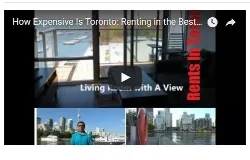
I have made a video on this and you can watch it by clicking here (Is It Expensive to Rent in Toronto?) or on the top left picture. After watching, it is up to you to determine whether the world’s best place to live (Toronto) is expensive to rent or not.