Toronto to Cairo - EgyptAir Economy Class Flight Review | Travel Blog

EgyptAir Economy Class MS 996 – YYZ to CAI Nov 28, 2019 Thursday

Toronto Pearson International Airport | Terminal 1

At the EgyptAir counter, there was a lineup, but it was moving fast. After obtaining my boarding pass, I headed to the Plaza Premium Lounge, where I used my own pass to enter, as economy class does not provide lounge access.

Inside the Economy Class Cabin

I had a box of chocolate, a gift for the flight attendant who was in charge of my section. He was really happy getting this unexpected gift and asked me many times throughout the flight if I needed anything.

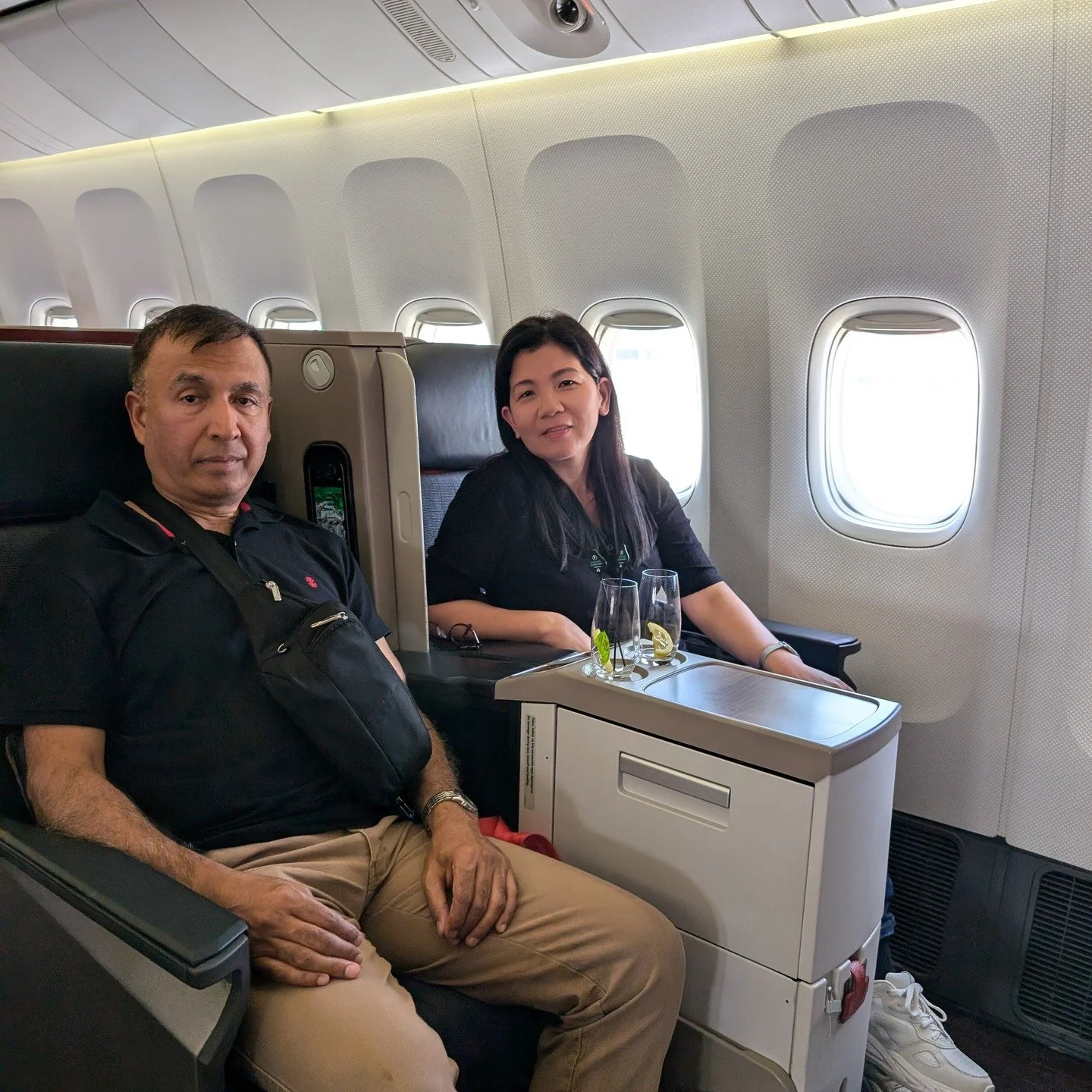
The aircraft was a Boeing 777-300. I already reserved an emergency exit seat by paying an extra $33.16 and it was totally worth it.

My seat, 42A, had lots of legroom and no one was in front of me. Throughout my flight, I was able to get out of my seat to stretch myself and go to the washroom many times without asking anyone to move.

I found that paying the extra $33.16 was pretty low for such a long 10H, 40M flight. Many other airlines charge double or triple this amount to book an emergency exit seat on shorter flights.

The Amenity Kit

Yes, EgyptAir provided an amenity kit in economy class. It was a basic supply of socks, an eye shade, earplugs, earphones, toothbrush and small toothpaste, pen, wipes, and hand sanitizer in a nice black case.

Food & Drinks

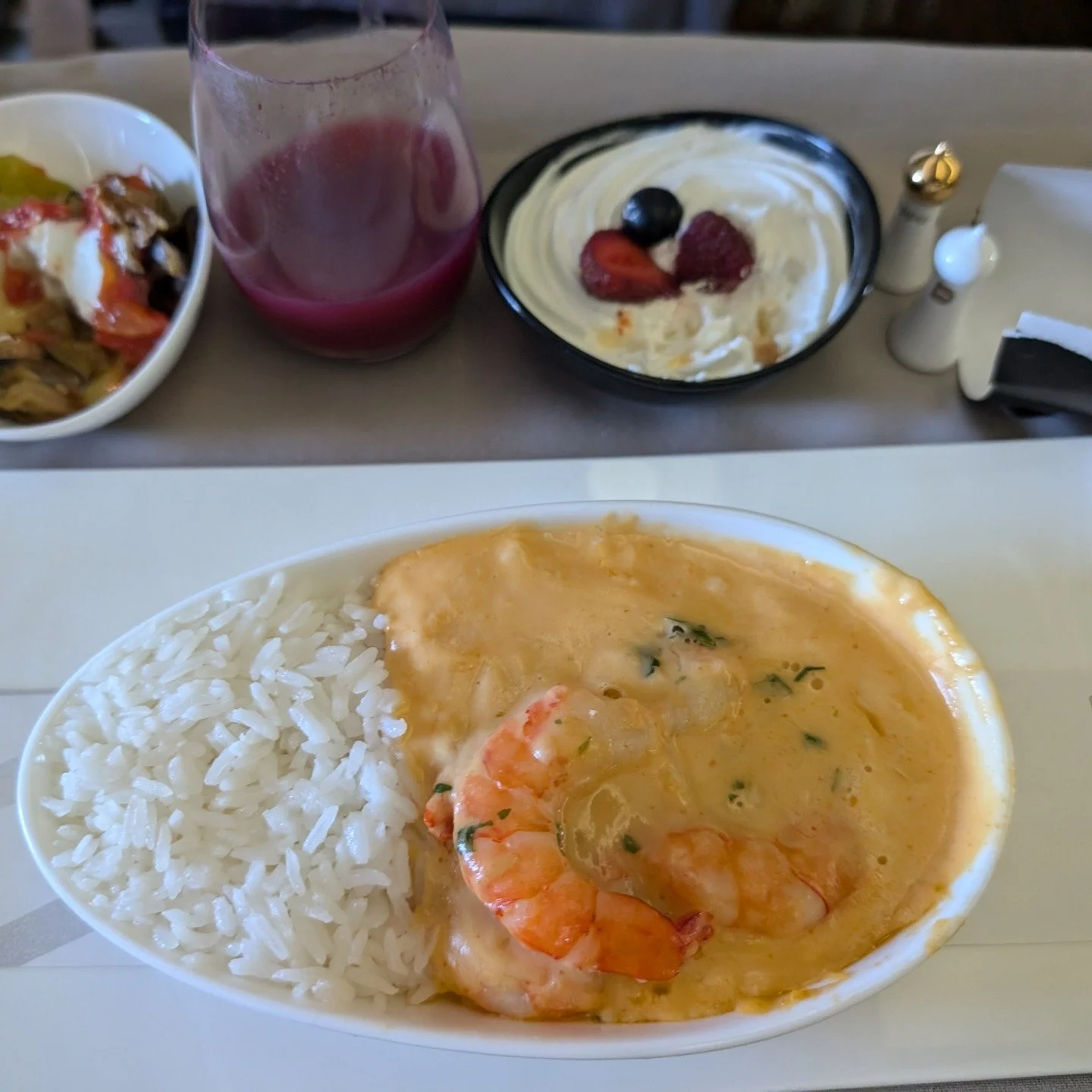
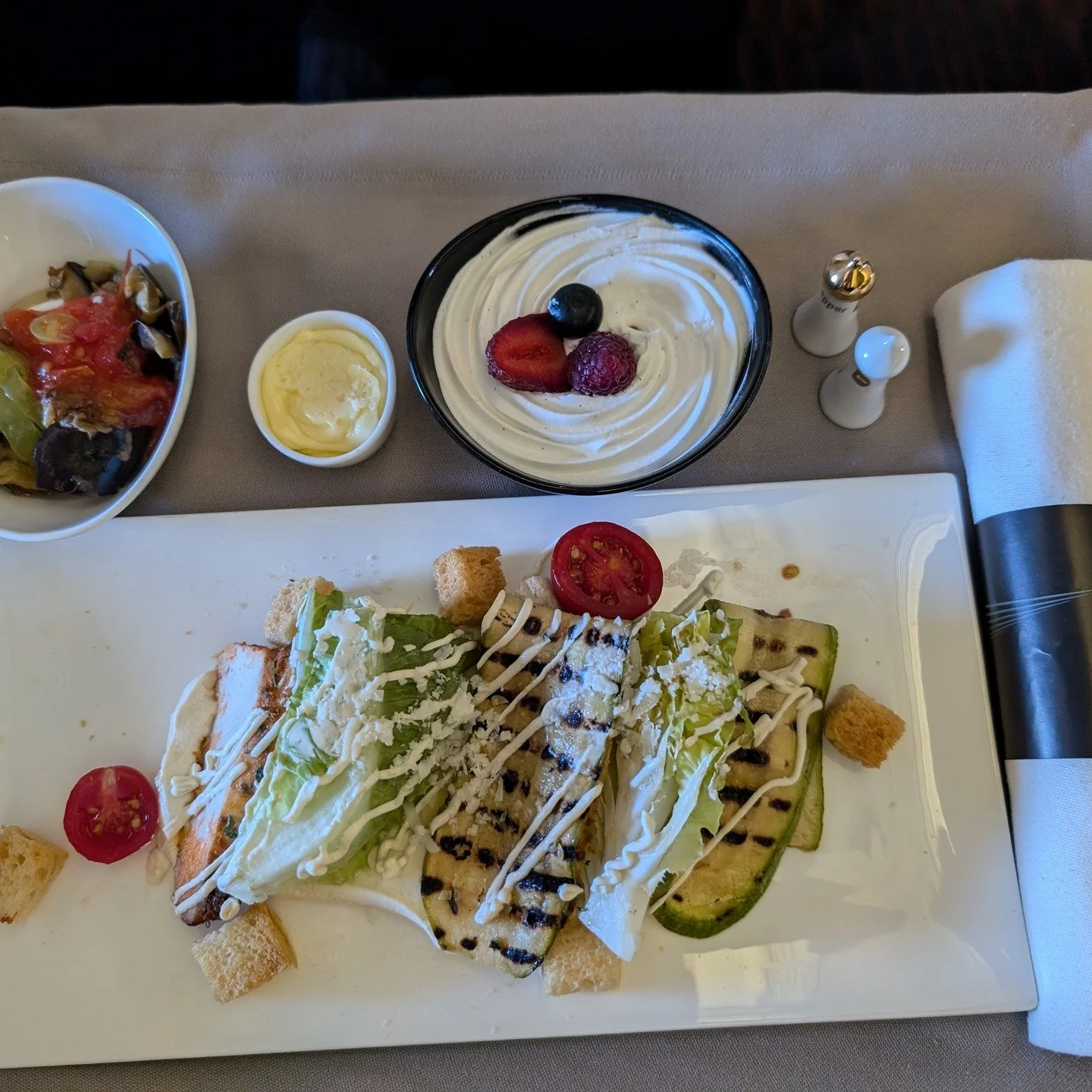
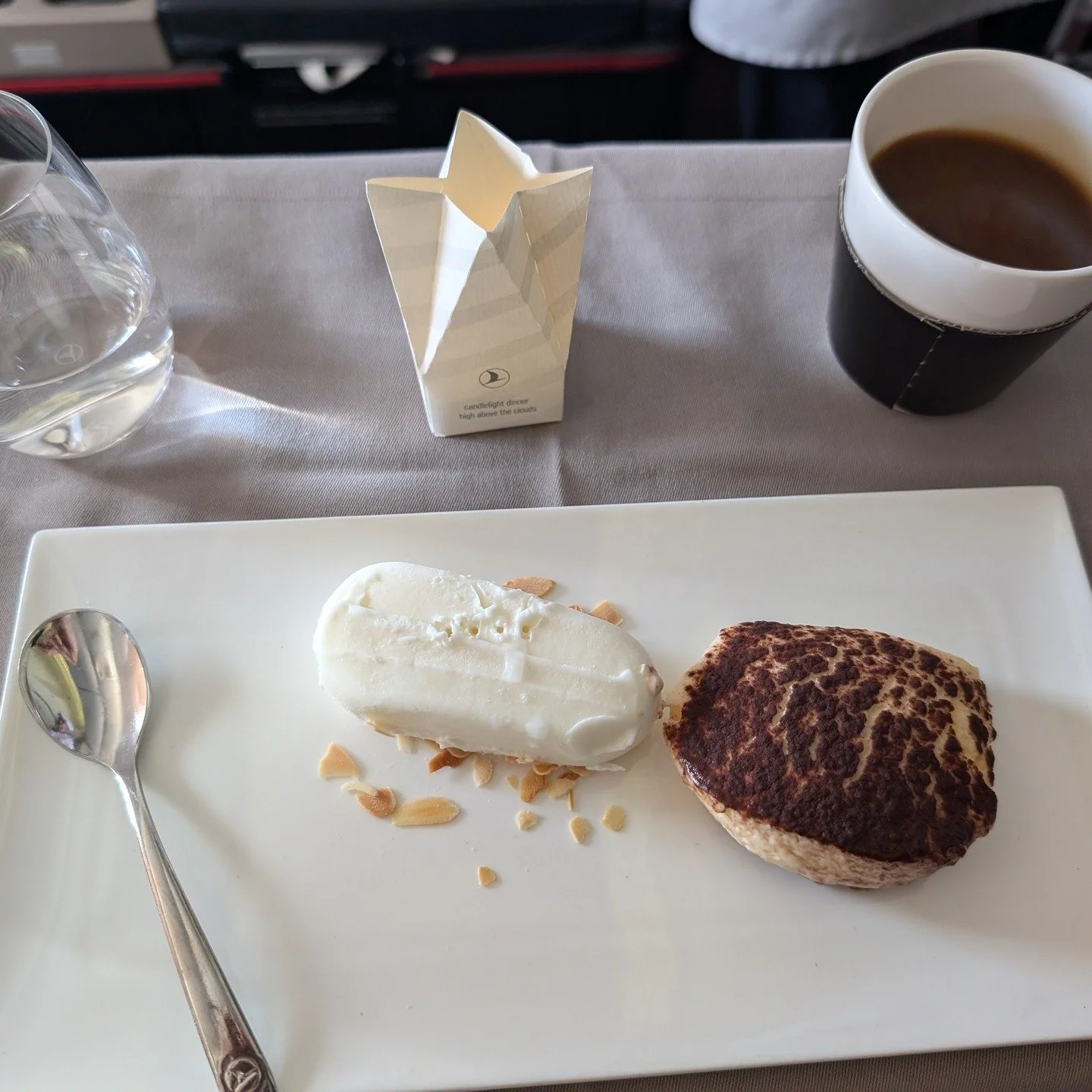
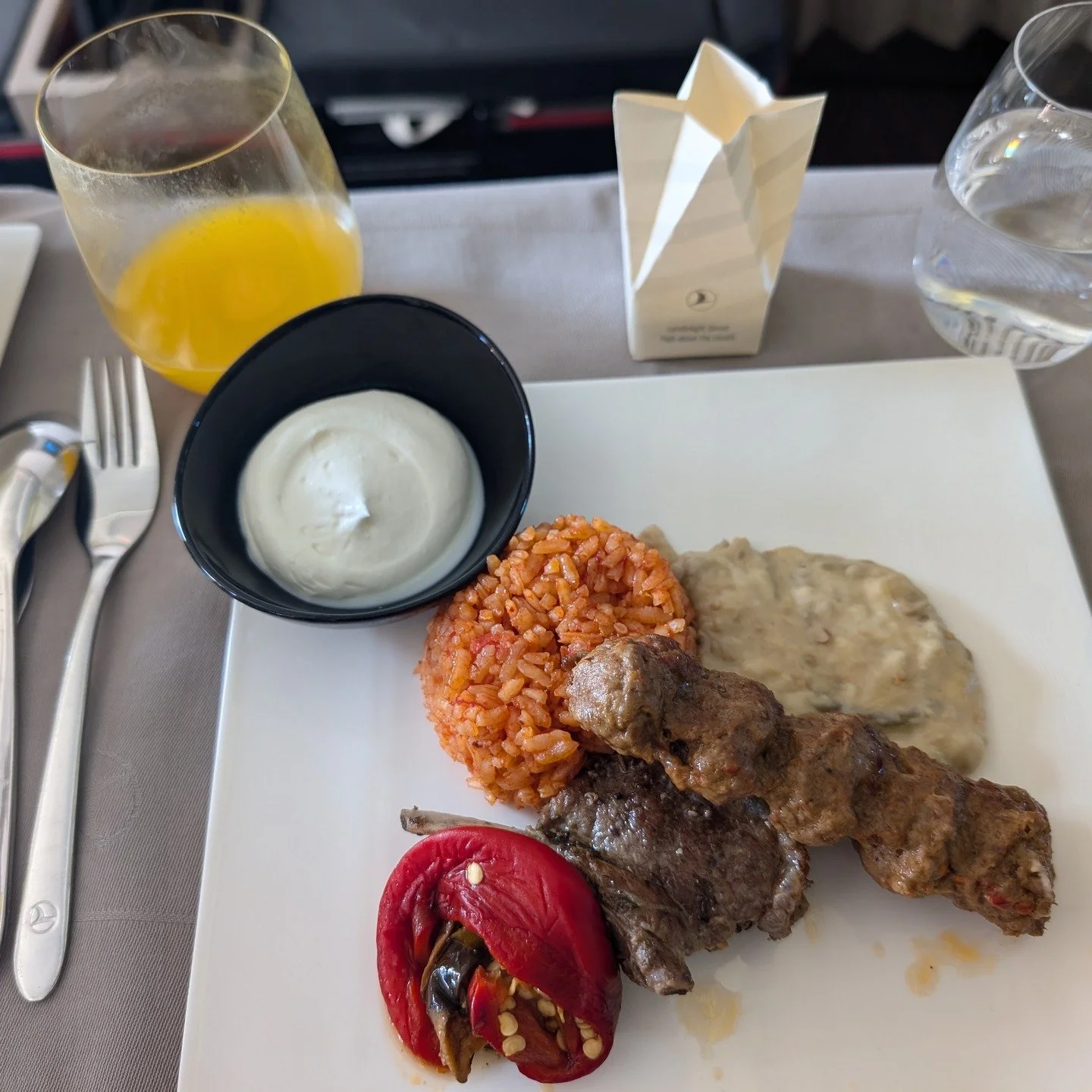
Because it was a long flight, there were several meals and in-between snacks served throughout the flight. Here is what I had:

- Dinner was beef biriyani, cheese cake, and fruit salad, soft drink.

- 2nd meal was a cheese sandwich several hours later.

- Breakfast was eggs, fries, fruit salad, juice

The food quality and quantity were very good and passed my expectations of economy-class food.

The Washroom

The washrooms were clean and even had some amenities. But this was such a long flight and had so many people that later on the washrooms were messy and there were no amenities left.

Entertainment System

There were fairly recent movies and TV shows, but I didn’t watch anything. There were lots of Arabic movies and other programs.  

Final Thoughts

Overall, the flight was much better than what I expected. The crew members were laid back, accommodating, and nice. I found nothing to complain about the crew and my experience in general.

However, the aircraft itself was old and showed its age, although it was clean and well maintained.

Before entering EgyptAir, I was ready to expect a bad flight experience because I read many bad reviews. But my own experience was nowhere near that and I was totally happy with my time on EgyptAir from Toronto to Cairo.

I will not hesitate to fly EgyptAir again.

HTC Panache Review | My First Smartphone

HTC Panache Review

First Published Date: July 24, 2011

HTC Smart Phones – Miles Away From Other Smart Phones

I left home deciding to buy a Samsung Nexus S smartphone. However, after seeing HTC Panache and Nexus S side by side, there is no way anyone can pick Nexus S over HTC Panache. This is my first HTC phone and I am impressed with some of the features HTC added to this phone which put the HTC Panache miles apart from other smartphones – and I am coming into that.

Let’s look at some of its features:

– Powered by Android 2.3 with HTC Sense.

– 1 GHz powerful Snapdragon memory

– 3.8-inch LCD WVGA capacitive touch screen

– Memory 1.1 GB eMMC/786 MB RAM

– Comes with 8 GB microSDT card pre-installed, you can extend it up to 32 GB

– 5 MP camera with LED flash. Can record 720P HD video.

How It Feels to Hold

The HTC Panache is a strongly built 168-gram camera. Its aluminum backplate, rubberized edges and solid body give you the feeling of ruggedness and durability. Its slightly weighted body does not interfere with regular use and feels good to hold in the hand.

Portable Wi-Fi Hotspot

If you have unlimited Internet on your phone, you can use it for your home without paying a separate Internet service and can save hundreds of dollars annually. I discussed more having Free Internet in the past. However, until now I had to use a cable to connect my phone and computer to get the Internet (tethering). The HTC Panache runs Android 2.3 which has built-in Wi-Fi hotspot and Tethering, you don’t need to connect using a cable anymore. You just need to change the phone’s settings to turn on Wi-Fi Hotspot (which can be done in 20 seconds) to use the Internet wirelessly. I must say, this is the feature I am enjoying most.

Distinctive HTC-Only Features That Put The HTC Panache Miles Away From Other Smart Phones

Here are some features that I like most about my new HTC Panache. I never thought these futuristic features would be available in a present-day phone.

– The HTC Panache knows when it’s in your pocket or in a bag and rings louder so you hear it.

– When it rings in regular condition, the ringer volume gets lower once you touch it to pick it up. If you want to silence the ringer volume completely, just flip it over. HTC made this feature especially for those times when you are in a meeting.

– When you are talking on your phone and want to switch to the speaker, just flip it over.

– It takes an amazing HD video. See it for yourself, as I have posted a video clip taken with the HTC Panache.

– Stream music, pics, and videos from the HTC Panache to your TV or home theatre system via DLNA certified devices.

– Many other HTC features you will not find in any other Android phones.

What I Don’t Like In The HTC Panache

Although the HTC Panache can shoot incredible HD video and you do not need to carry a separate camera like the Samsung Digital Camera to record HD video, its regular 5 MP digital camera cannot take good quality pictures without bright light. Also, I am not impressed with its speaker and it does not sound like a stereo speaker.

What the Future Holds for Smartphones

Smartphone technology is advancing so rapidly that it’s hard to predict with precise accuracy what our smartphones will be like in 10 or 20 years. One thing I can say with certainty that it will be our most important toy over anything else like laptops or desktops if it has not become one already.

How Many Credit Cards Do You Need?

How Many Credit Cards You Should Have

First Published Date: August 16, 2011

When I was a student, getting my first credit card with a $500 credit limit gave me the feeling of conquering a country – it was a feeling nothing like I had experienced before. And then I got addicted to applying and getting more credit cards. I wanted to have them back then just because they looked cool and I wanted to have a collection of all sorts of cards. However, things are different now. There is no need to acquire cards one after another just to make your wallet fat. Today, I am going to talk about how many credit cards you should have and if there is any perfect number you need to stick with.

Let’s look at how having more than one credit card affects you in terms of your FICO® score. Your debit-to-credit ratio is your combined credit card balance divided by your combined credit limit. Credit-to-debit ration represents 30 percent of your credit score. If you carry a balance on your credit card, the more credit cards you will have, the better (lower) your debit-to-credit ratio percentage will be. For example, if you have one credit card with a credit limit of $1000 and you spend the full $1000, your debit-to-credit ratio will be 100 percent. However, if you have 4 credit cards with $1000 credit limit each, spending the same $1000 will make your debit-to-credit ratio only 25 percent. So having more credit cards does help in your FICO® score; however, you should not worry too much about this 30 percent of your score as there is 70 percent remaining to improve your score. And besides, if you have difficulty controlling your spending, more credit cards translate into more spending.

Now, how many credit cards do I think you should have? There is no ideal answer because it all depends on your personal situation. However, from my point of view you should have at least three (VISA, MasterCard, and American Express) major brands. One of the main benefits of having all is that not every place/merchant accepts all cards and having each of them will come in handy, especially when you travel. Another benefit of having more than one card is you can use them for different purposes.

As I mentioned earlier, if you have a spending problem, strictly stick to one credit card and only use it for emergencies. And then when you think you are responsible enough to handle more credit cards, you can look into getting more based on your needs.

Canadian Gold ETFs

Gold ETFs Canada

First Published Date: August 24, 2011 ADawnJournal.com

As global stock markets stumble and take a deep plunge, investors across the globe take shelter in one specific metal – gold. Gold has had an immense impact on human civilization. It caused the fall of nations, pushed the Age of Discovery, made some people rich and others poor. It is something that we all cherish and we all want more of it. In search for more gold, what can be better than gold ETFs? Today, I am going to discuss some gold ETFs I like. ETFs trade on stock exchanges just like stocks and you can buy them through your discount brokerage account or through a licensed financial advisor. For more information on ETFs, please visit A Dawn Journal ETF Section.

Central Gold Trust ETF (TSX: GTU.U) – Established in 2003, this is a pure gold trust holding gold bullion stored in the treasury vault facilities of a bank in Canada. As of the end of December 2010, GTU assets consisted of 604,676 ounces of gold bullion, 6,156 ounces of gold certificate totalling 610,832 ounces.

iShares S&P TSX Global Gold Index Fund ETF (TSX: XGD, MER: 0.57% ) – This ETF tracks the performance of the S&P/TSX Global Gold Index – which tracks the world’s leading gold companies. iShares ETFs are managed by BlackRock Asset Management Canada Limited.

Claymore Gold Bullion ETF (TSX: CGL, MER: 0.54%) – This ETF physical gold and tries to replicate the performance of gold bullion price.

iShares COMOX Gold Trust ETF (TSX: IGT, MER: 0.40% ) – This is a U.S. gold ETF that trades on the TSX. It owns physical gold and trades in Canadian dollars.

Horizon COMOX Gold ETF (TSX: HUG, MER: 0.65%) – This ETF tries to track the performance of the COMEX gold futures. BetaPro Management Inc. is the portfolio manager.

BMO Junior Gold Index ETF (TSX: ZJG, MER: 0.55%) – If you like junior gold companies, this may be for you. This ETF tracks the performance of the Dow Jones North American Select Junior Gold Index.

DisclosureThis article is for information purposes only and No information is intended as investment, tax, accounting or legal advice, or as an offer to sell or buy or solicitation of an offer to sell or buy, or as an endorsement, recommendation or sponsorship of any company, security, ETF, or fund. The author assumes no liability for any inaccurate, delayed or incomplete information, nor for any actions taken in reliance thereon. You bear responsibility for your own investment research and decisions, and should seek the advice of a qualified financial professional before making any investment decision. I own some of the ETFs mentioned here.

Some Facts About Chile’s Economy

Economy of Chile

First Published Date: September 7, 2011

Chile, a country in South America, is considered the economic miracle of Latin America. In only two decades, between 1988 to 2008, its economy doubled and then tripled, which means its economic growth increased 600 percent. According to the 2011 Index of Economic Freedom, Chile has the 11th freest economy on earth and Chile has the highest degree of economic freedom in the Central and South America region.

It took Chile almost three decades of endeavour to reach today’s position. Chile has a market oriented economy characterized by high volumes of foreign trade, sound economic policy, and reputed financial system. It’s no wonder that Chile enjoys the highest sovereign bond rating in South America. Chile was the first South American country to join the Organization for Economic Cooperation and Development (OECD) in 2010. In 2006, Chile became the highest nominal GDP per capita country in Latin America.

Chile was one of the few nations that handled the 2009 global economic downturn well and also the financial havoc caused by the 2010 earthquake. Its economic growth was 1.5 percent in 2009 cent and 5.2 percent in 2010. By law, the Chilean government is required to a fiscal surplus of 0.5 percent of its GDP. This used to be 1 percent before 2008 and was waived for 2009.

Chile’s independent Central Bank targets to keeps its inflation within 3 percent. However, inflation reached closer to 8 percent in 2007 and 9.9 percent in 2008. But inflation decreased to 2 to 2.7 percent in 2009 and 2010 – keeping it in line with Central Bank’s target range. Unemployment rate in Chile was 8 percent in 2010. Percentage of population below the poverty level stands around 14 percent. It was 46 percent in 1987 and 18 percent in 2005. Chile’s public debt to GDP percentage is 6.2 percent, which is lower than most countries. For example, United State’s public debt to GDP percentage is 99.32 percent.

Exports account for one third of Chile’s GDP and minerals account for half of the value of exports. Chile is the world’s largest producer of copper, with recorded copper reserves for 200 years and Chile’s copper alone provides one-third of its government’s revenue. Government owned CODELCO is the world’s largest copper producing company. However, Chile has beefed up its non-traditional exports as well, such as wood and forestry products, paper and pulp, wine, seafood, fish, fresh and processed fruits and vegetables. China, Japan, United States, Brazil, and the Netherlands are Chile’s largest export market.

Chile, while greatly improving its economy, still has some work to do. The country still has a great deal of poverty and a significant poverty gap, alone with environmental problems. The dependence on copper, weak employee skills and insufficient training, inadequate regulation, limited credit access, and limited product and technology infrastructure are some of the issues Chile will have to deal with as the country continues to move into the future.