Time To Invest in Stocks?

Should You Invest Now?

Published Date: May 03, 2009


There will be no small number of people looking to save every penny they can get their hands on right now, in the midst of a lending crisis that has permeated even the most disciplined economies in the world. Putting money aside – squirreling would be the best way to put it – is certainly quite tempting as things stand, not knowing when the recovery will really begin in earnest. In order to be sure of having money in the months to come, it is perfectly sensible to put some by. On the other hand it could be said that if you don’t invest a bit now, there will never be a better time.

Sure, there will be some reluctance on the part of any of us to put money where it might lose value, and the fact of the matter is that investing does carry that risk – “remember, investments can go down as well as up” ring any bells for you? Without that kind of fluidity, there would be no chance of making a bit of money on the stock market, or through any kind of investing – and you would be better off just putting it in a savings account. What we can be certain of is that several investments are now at as low a value as most of us can remember – and ripe for the buying cheap.

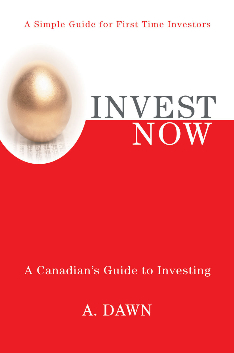
Award-winning book Invest Now is jam-packed with timely information and timeless advice for the beginning Canadian investor. To purchase a copy, visit Chapters Indigo or buy online – Invest Now: A Canadian’s Guide to Investing

No-one with any knowledge of such matters will tell you that your investment is guaranteed to increase in value, and less still will you be told that you will get an instant return, so it is worth having a savings plan at the same time. The chances are, however, that a small investment will have an initial small return, and can even act as a dry run for investing in greater amounts. As rules of thumb go, “Only invest what you can afford to lose” is a good one. It will allow you to learn the ropes in a less pressurized context.

Of course, investing can be a daunting prospect. If you stand to make any kind of money at all, the chances are that it will carry a frisson of nerves as you watch and wait for the right moment to sell or stay in. The chances are that on your first investment you will be tempted to sell as soon as you realize any kind of profit on the deal. While there is every reason to be happy at turning a profit, it is worth taking into account that people who have been playing the market for longer will stay in longer than those who haven’t. The reason for this is that they have learned to recognize when a stock will keep rising.

It is worth purchasing a guide to investment because these are invariably written by people who have done it and been successful. Warning signs that might go ignored by the novice will be covered in these guides, as will those false alarms that make first time investors panic and get out. When you are investing for the first time, it is good to have this reassurance.

To streamline and minimize blog maintenance, I will be discontinuing maintaining the Canadapersonalfinancewebsite.com website (however, I will still hold the domain). I will gradually move all articles from this site to A Dawn Journal. This article originally published on the above website on May 3, 2009.

TD First Class Visa Infinite Points Value Decrease

TD Devalues Visa Infinite Points

First Published Date: June 22, 2015

If you are a TD First Class Visa Infinite credit card holder, you will see lower rates and lose some value in your points redemption starting August 16, 2015. You may want to consider redeeming your points before August 16 (if your circumstances allow), so you don’t get dinged by TD.

As of now, before August 16, the redemption rate is 200 points for $1, but it will be devalued at 250 points for $1 starting August 16. What it means that if you have 100,000 points, you will get $500 in travel spending, but after August 16 the same 100,000 points will fetch you $400.

TD First Class Visa Infinite provided 1.5 percent return on your purchase spending, excluding TD Expedia spending, until now. This rate will go down to 1.2 percent once the devaluation kicks in. Although TD said you would still get 1.5 percent rate on your regular purchases if you redeem over 300,000 points, but the truth is you will never go back to the old 1.5 percent return level as the first 300,000 points will be counted as 1.2 percent return – making the total return on regular spending above 300,000 points ($1,200) a low 1.33 percent.

This is obvious that TD will lose lots of clients after the devaluation as TD First Class Visa Infinite will lose its ranking among other travel reward cards. And there are so many better cards out there, unless you don’t mind losing your spending’s worth and sticking to TD due to allegiance. As I will be writing on more credit cards to maximize your reward returns, don’t forget to keep an eye on A Dawn Journal. Visit here if you would like to find out more about TD’s recent devaluation announcement.

Breakfast at a Restaurant in Aswan Near the Airport | Aswan

Just Arrived in Aswan | Egypt Travel Blog: Day 3 (Part 24) 02D20

Egypt Travel Blog: 10 DAYS Egypt Explorer - Felucca Cruise & Red Sea

Our bus stopped at the Aswan airport to pick up our tour mates who flew overnight from Cairo instead of taking long bus trip. However, they had to leave the Oasis hotel in Giza so early (around 4 AM) that my long bus trip was not all that bad in comparison.

My sun blocker was in my bag, which was in the luggage compartment of the bus. I asked our tour guide if I could take it out from the bag. He mentioned that there are regulations that busses cannot open the luggage compartment (or at least busses that not are commercially licensed to operate at the airport) in the area, so I had to wait for us to leave the airport to get my sunscreen.

Today’s breakfast was included in the tour package. The restaurant was a large separate facility in the airport area, but not connected to the airport. Our bus parked right in front of it in the parking lot.

I went to use the washroom to freshen up. The line was not too long. Once I returned, I saw most of our tour mates sitting together. Our tour guide handed us our pre-made breakfasts one by one.

It was nothing fancy. It looked like a pita bread stuffed with falafel or something like that. It tasted OK, but nothing great and not too spicy.

The free breakfast catch was that it didn’t come with a drink, so everyone was forced to buy an overpriced drink. I already had bottled water, so I only bought a coffee. The coffee was not that great either, but after a long bus ride and no sleep it felt like heaven.

From here we would go to the famous High Dam of Aswan. We were scheduled to go to the hotel first, but due to lack of time we were to finish all our excursions first and then go to our hotel.

Tips On Buying A Second Home Abroad

What You Need To Know Before Buying A Second Home Abroad

First Published Date: Oct 21, 2009

Buying a second home is something that, for a lot of people, means they have truly arrived on the scene. Buying a second home abroad adds that little bit to the mix, giving you a spread in the world, a base from which to travel further. For a Canadian or American, the immediately obvious choice would be a home in the Caribbean, while anyone living in Europe has an enviable range of choices too, as do Australian residents. But before you choose to move to a new country, you need to keep aware of some important principles.

Firstly, it is essential to do some research before you move anywhere, but all the more so when you are moving to another country. However many similarities there may be between your first home country and your second home country, there will be subtle differences that can be quite disruptive if you have to face them every day. They are always surmountable, but only if you do prior research and make sure you are equipped to face the changes.

Secondly, it is necessary to become a part of the community wherever you move to. This does not mean you have to hold a party immediately on moving in and invite everyone to it. What you do need to do, though, is be active. Even if it is just going out for a walk in the morning to buy the newspaper, dining out every so often, or joining some clubs locally, it will vastly aid the settling in process.

You should also learn the language, if you are moving somewhere that has another language. There are many ex-pat communities in countries all over the world. Without a doubt, there are varying levels of welcome extended to them by the host communities, and by far the greatest level of welcome is that which is extended to those who can be bothered to learn the local language. It is simply common sense. If someone makes the effort to speak a second language, it demonstrates a level of courtesy which will be appreciated and reciprocated.

You should not expect to fit in immediately in your new country. No matter how prepared you are, how prepared you feel you are for the change of moving to a new country, there is always a settling in period. It is something which always makes demands of a person, because there is a total change. Things you have taken for granted are no longer there, little things that you didn’t realize you appreciated about your home country will suddenly become big things. Does it slightly irritate you when you are treated in a certain way in your home country? When the locals of your new home country fail to treat you in that way, you will resent it slightly. A lot of little changes go together to make a big change. Does this mean you shouldn’t go for it? No, it certainly doesn’t. The challenges we face in life make it what it is. Go for it.

To streamline and minimize blog maintenance, I will be discontinuing maintaining the realestateexpedition.com website (however, I will still hold the domain). I will gradually move all articles from this site to A Dawn Journal. This article originally published on the above website on Oct 12, 2009.

Global Millionaires Number Hits Record High

New Stats About Millionaires

First Published Date: June 24, 2015

How many people became millionaires last year? About a million, at a record pace for the sixth consecutive year. A recent report published by the consultant Capgemini and RBC Wealth Management.

India may be a poor country, but millionaires seem to be shining in India more than anywhere else. Millionaires rose at a record pace at 26 percent, which is the biggest percentage increase among all other countries.

Here are some other highlights from the report:

– World millionaires rose by 920,000 to a record high of 14.6 million.
– One third or more of the new millionaires live in the US (345,000).

– Global assets held by the millionaires reached a record high $56 trillion.

– The richest millionaires, those have $30 million or more, held 35 percent of the wealth, but only 1 percent of the total millionaires.

– The U.S. is where the most millionaires live followed by Japan, Germany, and China.