Mutual Funds 101: Part 1
First Published: ADawnJournal.com May 30, 2010
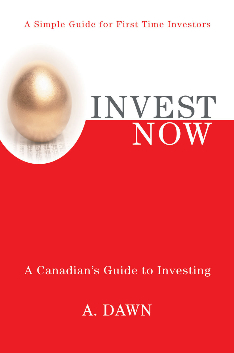
The following is an Excerpt from my first book Invest Now. Invest Now is jam-packed with timely information and timeless advice for the beginning Canadian investor. Invest Now covers a broad range of topics including Internet Scams. To purchase a copy, visit Chapters Indigo or click here to buy online – Invest Now: A Canadian’s Guide to Investing
Mutual Funds: The First-Time Investor’s Friend
If you had a friend who was very knowledgeable in the stock market, you would definitely want him to manage your stock investments. What if this friend agreed to do everything for a small fee? Wouldn’t you hire him? A mutual fund is just like this hypothetical friend. A mutual fund is a collection of investment products, such as stocks, bonds, T-bills, and so on. Mutual fund companies collect money from investors and hire professionals to manage your money. These professionals are called fund managers. When you buy a mutual fund, you buy a portion of the fund (or a portion of what the funds hold altogether).
Why Are Mutual Funds Suitable for First-Time Investors?
You need years of experience, lots of money, intensive knowledge, and various tools to pick an individual stock. A mutual fund does all that for you while keeping risk to a minimum. It’s no wonder that mutual funds’ assets are skyrocketing with the speed of a space shuttle.
To pick the most suitable funds for you, you need to know a few things. Let me start with the advantages of mutual funds; you can use these advantages to overcome obstacles you will face as a first-time investor.
Advantages of Mutual Funds
Low Minimums and PAC
Low minimums are the best feature mutual funds offer. Have you heard your friends saying they don’t have enough money to invest, and that’s why they never save? If you are using same excuse, put it aside. Most mutual funds will let you start with as little as $500, and some will let you start with just $100. If you agree to let fund companies take money out of your bank account systematically—either monthly, weekly, biweekly, quarterly, semi-annually or annually, you can start with as little as $25. This convenient option is a good one for those who can’t put in one lump-sum payment to start with. You will not find this type of convenience investing in stocks and bonds. The above-mentioned feature is called PAC (pre-authorized checking), AIP (automatic investment plan) or SIP (systematic investment plan). I will use PAC in this book, because PAC is widely used and recognized.
PAC is nothing but systematically investing your money with a financial institution. One great advantage of having PAC is that it gives you the power of dollar-cost averaging.
Dollar-cost average simply refers to the averaging of your cost per share or per unit. Suppose you are running a PAC for $25 monthly on the 15th of each month. Your mutual fund unit price will not be the same on the 15th of each month. But you will be adding the same $25 each month. If unit price goes up, you will be buying fewer units. If unit price goes down, you will be buying more units. Running a PAC year after year and calculating your average cost per share after a few years will prompt gains. Research has shown that if you do dollar-cost averaging, you end up buying more units rather than spending one set lump sum.
Dollar-cost averaging on stocks or bonds will cost you a lot of money, with transaction fees every time you buy. But you can do a dollar-cost average on mutual funds without additional cost or transaction fees. Just run a PAC, and you are good to go. This feature is very suitable for first-time investors.
Professional Management
Choosing an individual stock or bond can be an enormous task for new investors. All the research and decision-making can be daunting. Everyday investors don’t have the tools or resources to make a prudent decision. When you buy mutual funds, you are buying the expertise and service of the group of professionals who manage those funds. Each group consists of a fund manager and a few analysts. This group is responsible for doing all the research and for deciding when and what to buy and sell. Basically, everything is done by the fund manager and his team. You don’t have to spend days and nights analyzing stocks and monitoring your portfolio. Remember, these professionals cost you money, but I will discuss how to keep your costs minimal.
Diversification and Convenience
Whether you are a stock or a mutual-fund investor, it is very important to diversify. The old saying “Don’t put all your eggs in one basket” still applies. Diversification reduces your risk by spreading your money across different companies, countries and types of assets. A mutual fund is lot more diversified than a stock or a bond, because a typical fund holds 20 to 50 stocks or a mixture of stocks, bonds, T-bills and so on. I will share my own simple diversification strategy a little later.
Diversification can be a headache if you invest in stocks or bonds. You need to do lots of trading, and you have to keep track all of your portfolios constantly. If you don’t mind the complex task of managing your own portfolio and enjoy doing it, that’s fine. But such an endeavour would require a lot of effort for first-time investors as they pick different types of investment products and attempt to manage them. A mutual fund gives you exposure throughout the world with diversification and convenience—nothing needed from your side.
Regulation
When I first started investing, a junior mining company’s stock was going through the roof. This ten-cent stock was trading at close to two dollars, and rumour was it would reach five dollars soon. I started dreaming of becoming a millionaire in couple of weeks and had already made some plans to retire in the Bahamas the next month.
My emotions ran high; I did not hesitate to invest a few thousand dollars. My investment went up for one day. Starting the second day, my investment started to fall, and after one week my investment was down to four hundred dollars. Basically, I lost all my money. In a mutual fund, it is unlikely that you will lose your money overnight. In the financial world, nothing is guaranteed, but a mutual fund offers a better degree of protection than stocks due to stringent rules and regulations. Mutual funds are highly regulated, ensuring how funds are managed and how investors are informed.
A few points on mutual funds are worth mentioning
A mutual-fund company does not physically hold its assets. A third party, called the custodian, holds securities on behalf of the fund company. If the fund company is in trouble, your money is protected. Fund managers can’t just walk out with your money. The custodian can be either a bank or a trust company.
Fund companies need approval from unit holders to make any significant change. Also, any change in the fund’s investment objective has to be approved by unit holders.
Fund companies have to disclose the fund’s holdings on a regular basis.
Fund companies have to disclose the fund’s unit value regularly.
Fund companies need to publish procedures for the purchase and sale of funds.
Remember, these rules are in place to provide you some degree of safety. No investment is guaranteed, and any investment can decline in value.
Liquidity
Mutual funds are very easy to sell and buy. Your money is not tied up for any specified terms or years. Keep in mind that, except for money-market funds, you will incur an early redemption fee if you redeem your fund within the first sixty days of purchase. Consult your mutual-fund prospectus to find out more.
Transaction Cost
Mutual funds offer another convenient feature. Suppose you want to buy a few Canadian stocks and a couple of international stocks to start your investment. You will be spending the following if you are buying stocks:
(Assume trading cost per transaction is $29)
Three Canadian stocks trading on TSX = 3 × $29 = $87 CAD
Two American stocks trading on NYSE = 2 × $29 = $58 US
Imagine your cost in buying on the European and Asian exchanges. Selling would be equally expensive. You can avoid all these costs if you buy mutual funds. However, you do pay on mutual funds, and I will explain how in a moment.
Disadvantages of Mutual Funds
Nothing in life comes without disadvantages. Now that we have discussed the pros of mutual funds, let’s go over the cons.
Fees and Expenses
When you buy mutual funds, you pay fees to compensate companies for doing all the work. These fees are called management-expense ratios (MERs). Depending on what type of load (front load, back load or low load) you buy, you might pay commission and redemption fees. I will discuss MERs and load a little later in order to show you how to keep your cost minimal.
No Insurance
The Canadian Deposit Insurance Corporation (CDIC) does not insure mutual funds the way it insures bank accounts, loans and so on. Keep in mind that other investments, such as stocks or bonds, are not insured by the CDIC either.
Loss of Controls
Fund managers, not mutual fund holders, make the decisions on a fund’s portfolio. When you buy mutual funds, you give up your authority and abide by the fund company’s decisions.
Trading Limitations
Stocks can be traded as many times as you want throughout the day (North American markets are open from 9:30 a.m. to 4:00 p.m., Monday through Friday). Mutual funds are priced only once a day, after the markets close. Regardless of how many times you buy or sell in a day, you will get only one price for that day. It does not change every second, like stocks.
Cash Holding
Mutual funds need to hold large amounts of cash to pay for redemptions (when someone is selling). Had this cash been invested, you would have made money on this cash. In other words, investors lose growth potential on that cash portion.
Mutual funds carry some other disadvantages, but these are the most important ones.
Next, let’s discuss the fees and expenses you pay when you buy mutual funds. Fees and expenses are very important to know, as such information allows you to cut costs by investing carefully. You need to do that to become a successful investor.