Global X S&P/TSX Venture 30 Canada ETF: First Global ETF Targeting Canadian Emerging Companies

Global X Funds Launches Canadian Junior Mining and Exploration Companies ETF on NYSE Arca Exchange

First Published Date: March 24, 2011 ADawnJournal.com

In these times of worrying investments, many investors want to go with something that is a bit safer. Hence the purpose of exchange-traded funds, which do not try and beat the stock market, which many will tell you is impossible, but only to replicate it. With an exchange traded fund, or ETF, you are trading based on an exchange, rather than individual stocks. This then allows you more security because not all your eggs are in one basket and you can therefore ensure you are okay if the market goes down.

Recently it was announced that Global X S&P/TSX Venture 30 Canada ETF was launched and it focuses on one of the strongest areas of the Canadian economy; energy and commodities. This ETF is split between materials and energy sectors, with slightly more material stocks in it than energy. This gives you a good mix in case one of the sectors goes down. Some of the main stocks on this ETF include Atac Resources, Rainy River Resources and Canacol Energy.

Of course, that is not all the ETFs you can choose from in Canada. One of the most well-known and used is the iShares MSCI Canada ETF. This ETF covers more range than the other ETF mentioned here. ECW, as it is called on the trading floor, has half of its portfolio made up of material and energy stocks, The rest of the portfolio is mostly made up of financial stocks. This is important because it gives you three different sectors that you can work with in order to ensure you get the most diversified portfolio that you can. The main stocks on ECW are Suncor Energy and Canadian Natural Resources.

When you are trading on the market, you want to ensure that you have a bit of relative safety so that you do not lose everything that you have. Many investors put their hopes on risky stocks and ending up losing everything during the financial crisis. If you are in for the long haul and would like to have a few stocks to diversify, then you can look at these ETFs. ETFs are known for providing better level of safely than picking individual stocks. With ETFs, you can invest in specific sectors or even stocks that only match your morale code. For example, you can choose ETFs that only have stocks from companies with good employee records and others that are not related to weapons or tobacco.

If you like to invest in Canadian companies, then you may want to look at investing in these ETFs, which are working on stocks that are in the highly profitable energy and manufacturing industries. In the case of the energy industry, it was one of the few industries in Canada to continue to do well despite the financial meltdown.

If you are thinking of investing with ETFs, then these two ETFs are the ones you can put in your research list Don’t forget to do your research making any financial decisions, and make sure to find the product that best suits your needs.

Link: Global X Funds
The Importing and Exporting of China

China Import and Export

First Published Date : March 31, 2011 ADawnJournal.com

China is the second largest economy on the planet and that has a lot to do with its surplus workforce and high amount of natural resources. Currently, China is also one of the world’s largest importers and exporters, something that is helping to fuel the country into the future.

In 1998, China had a global trade of $324 billion and that same year, China reduced its import tariffs from 35 per cent to 23 per cent and then again to 17 per cent. This allowed China to join the World Trade Organization, which has completely changed the country. Only 10 years after making those changes, China now has a global trade value of $2.4 trillion. It took six years (1988 to 1996) to go from $100 billion to $200 billion in global trade, and only seven years to go from $200 billion to $500 billion. From there, it was only three years before China passed the $1 trillion mark.

Currently, China imports mostly capital goods and industrial supplies, most of which are high-technology equipment and most of those come from Japan and the United States.

Due to the high amount of surplus workforce in China, about 80 per cent of the country’s exports are manufactured goods, and most of these are textiles and electronic equipments, along with chemicals and agricultural products.

To attest to the high amount of exporting and importing going on in China, of the five busiest ports on the planet, China has three.

The United States is one of the largest trading partners of China, with the trade surplus reaching over $200 billion. A big reason for this is because of Wal-Mart, which is the seventh largest trading partner with China, ahead of the United Kingdom.

China also trades a great deal with Russia, amounting to over $40 billion. In the past few years, the exports of machinery and electronic goods to Russia has grown immensely, as has its exports of high-tech products. Russia is also the eighth largest trading partner with China, and China is Russia’s fourth-largest trading partner. China mainly gets energy such as oil from Russia, with most of it coming from train, or through pipelines like the proposed Eastern Siberia-Pacific Ocean pipeline.

Within China, there is the China Council For The Promotion of International Trade, which helps to promote China’s international economic and commercial interests. The group does this by developing co-operation among businesses and exchanges with countries around the planet. The group also compiles data, works with diplomatic agencies and is active to ensure that there are no trade issues.

China is a growing nation and one that will soon be the largest economy on the planet. As time goes on, its trade with other growing superpowers will increase, especially India, Russia, Brazil and the European Union. At the same time, trade with the United States may fall as the economy of the United States struggles to remain a dominant power within the international community.

Warren Buffet–The World’s Most Successful Investor

The Sage of Omaha

First Published Date : April 6, 2011 ADawnJournal.com

He is considered to be the greatest investor in history and is usually ranked as one of the richest men on the planet. He is Warren Buffett and he has become a legendary figure in the investment world.

Born Aug. 30, 1930, Buffett is the chairman and CEO of Berkshire Hathaway and is the third wealthiest person in the world with a net worth of about $50 billion. While Buffett is known for his immense fortune, he is also known for giving away money and has announced that upon his death, he will give away 99 per cent of his fortune to charities, including the Gates Foundation, which is the charity of another very wealthy man; Bill Gates.

Born in Omaha, Nebraska, Buffett was educated at Rose Hill Elementary School until his father was elected to Congress in 1942. At this point, Buffett moved to Washington with his family and attended Woodrow Wilson High School.

One of the most interesting aspects about Buffett was his keen business sense, even from a young age. He had an understanding of how to make money and he began making money as a child when he was selling chewing gum, magazines and Coca-Cola door-to-door. He also knew how to save money and began putting money away for a rainy day.

At the age of 14, Buffett had filed his first tax routine and even used his bicycle as a $35 deduction because he used it on his paper route.

At the age of 15, he bought a pinball machine for $25 and put it in a barber shop. Only a few months later, he had several pinball machines in many different shops across the city. This was just the beginning of what would be a legendary business career.

As a child, Buffett spent time in a stock brokerage that was near his father’s company and when he was 10 he went to the New York Stock Exchange. At the age of 11, he had three shares in Cities Service.

By the time he was out of college (University of Pennsylvania), Buffett had $90,000 in savings thanks to sound business investments and a good sense of the stock market.

He graduated with a degree in Business Administration and then enrolled in Columbia Business School because two of his financial heroes taught there. From there, he received a Masters in Economics and then went to the New York Institute of Finance.

Throughout the 1950s and 1960s, Buffett worked as an investment salesman and securities analyst and in 1970 he became a general partner at Berkshire Hathaway, where he is now the CEO.

In the 1952, he married Susan Thompson and his first child, Susan Alice Buffett was born the following year.

Only a few years later, he bought a five-bedroom house in Omaha for $31,500. The fact that he still lives there shows the incredible character of Buffett who could afford his own country, but chooses to live in a regular home, in a regular neighborhood.

Due to all his partnerships in various companies, by 1962, Buffett was a millionaire with a fortune over $7.1 million by 1962. That same year, he merged all the partnerships into one and bought Berkshire Hathaway

Throughout the 1950s, Buffett began to acquire stocks in media including the Washington Post and ABC.

From 1960, when he became a millionaire, to 1990, the fortune of Buffett continued to grow thanks to excellent investing and shrewd business deals that led him as a controlling shareholder in many large companies. Buffett became a billionaire on May 29, 1990 and only 12 years later he was worth $11 billion. At this time, he announced that 85 per cent of his Berkshire holdings would be given away over time, to five foundations. The largest donation was to the Bill and Melinda Gates Foundation.

In 2008, Buffett was on top of the world, literally. It was that year that he reached $62 billion in net worth, making him the richest man in the world and pushing Bill Gates off the top of the list, where he had been for 13 consecutive years. The next year, Gates was again the richest man in the world but Buffet was second.

One reason for the drop was the loss of $25 billion in one year by Buffett due to the financial meltdown and crisis of 2008 to 2009.

Even with the financial meltdown, Buffett bought General Electric preferred stock, netting him a good increase in net worth.

Buffett separated from his wife in 1977 but remained legally married to her until 2004 when she passed away. His daughter currently does charity work through her own foundation. In 2006, Buffett married his long-time partner Astrid Menks, who was 60 years old at the time and had been introduced to Buffett by Buffett’s wife. Buffet, his partner and his wife were very close and all remained friends for several years.

Unlike many other CEOs, Buffett does not make millions in salary, but instead brings home only $100,000 in salary, making all his money from investments.

Buffett is also a big fan of the game bridge and often plays it with Bill Gates. He is also a fan of Nebraska football and can be seen in the stands whenever he has time to attend a game.

Another interesting fact about Buffett is that he does not carry a cell phone, nor have a computer and he drives his own car, rather than have someone drive him where he has to go.

Naturally, a great deal of recognition has come to Buffett. He was named the top money manager of the 20th century by the Carson Group, as one of the most 100 influential individuals in the world in 2007 according to Time Magazine and he has received the Presidential Medal of Freedom from President Barack Obama. β€˜

An mild-mannered man, Buffett is truly unique in the world of business and a fascinating person to learn the world of investing from.

Should You Give Your Kids An Allowance?

Kid’s Allowance Teaches Money Management

First Published Date : April 13, 2011 ADawnJournal.com

Prelude

An allowance is an amount of money you give to your kids on a regular basis to cover their expenses. Experts have always debated over whether kids should get an allowance or not. One group says giving an allowance teaches kids nothing and it might even ruin their finances in the future. Another group says an allowance teaches children money management skills (through responsibility and discipline) and prepares them to better handle their finances in the future. I believe in allowances and if used properly, it can be a great tool to teach your kids finances at an early age. Today, I will present my perspective and will provide you some tips on this debated topic.

Why Kids Should Get An Allowance?

Responsible parents look after the family and meet its members’ needs. An allowance helps to meets family members’ needs. An allowance is an example of parents’ responsibility. A lesson kids are practically observing right here – responsibility.

An allowance nurtures the children’s ability to think and act independently. Don’t expect them to always spend their allowance properly. The objective here is to make mistakes and teach them to correct themselves as they go along.

Once kids have their allowance in their hands, it tells them something very important – money is not unlimited. This reinforces the idea that they have to spend it wisely (i.e., it teaches how to best make choices between many things) once they know that each time they spend on something, they will have less than they did before. You will see a significant reduction in their β€œI want this” items. This is how kids learn the concept of β€œdiscipline” and β€œmoney is limited.”

At What Age Should Kids Get An Allowance?

Kids start showing coin recognition and interest in basic money concepts as early as four. Depending on your kids’ interest and your comfort level, parents can start giving an allowance as early as age three to five.

How Much Allowance Should Kids Get?

There is a common approach on deciding an allowance – a weekly allowance representing a total amount equal to $1 for every year for age. For example, a four year old would get $4 every week.

However, I think this basic approach will not work in most situations as there are many other allowance deciding factors coming into play. You should consider the following factors when deciding on an allowance:

Β·    Your Income – Only you know what you can afford to give and what you can’t.

Β·    Your Kid’s Age – As they grow bigger, the allowance amount should increase as well to cover additional cost kids need to handle every year.

Β·    What The Allowance Should Cover – Be clear on what it should cover and what not, and then add all expenditures to check if this allowance amount is realistic enough. A good way to do this is to make a list of all items you think their allowance should cover and discuss it with your kids; this ensures that no important items are missing and that your children are kept involved in the process.

Β·    Where Do You Live? – You may want to consider the neighbourhood you live in when deciding an allowance amount. Do you think a kid living in Red Lake should get the same allowance as a kid living in Toronto? I would keep this is mind while making a decision.

Allowances and Chores Should Not Be Tied

It is not recommended to link allowances and regular household chores. Chores are regular family responsibilities and should not be tied with allowances. However, kids can get paid for special projects for which you would normally seek outside help such as cleaning the backyard, painting jobs, etc.

Keep Clothing Allowance Separate

You may find some type of allowances, such as clothing allowances or book allowances, are not easy to blend into regular allowances. An easy way to handle this is to keep these separate. For example, give your children a clothing allowance in the winter for winter clothing, give them money to buy books when the needs arise, and so on.

Do Not Give an Allowance without Proper Guidelines

The basic purpose of giving an allowance is to teach kids money management skills. If you just throw some money at your kids without proper guidelines, instead of teaching them money management skills, it will teach them indiscipline and bad money management skills. Always give the allowance with proper guidance – show them how to spend it and break it down into small pieces, such as 10% should go to the piggy bank, 10% for a science magazine, 10% for charity, and so on.

Last Word

Money skills are not taught in school. Giving an allowance in a responsible way can open up endless possibilities to teach kids money skills and financial responsibility, and the lifetime results are immeasurable.

Taipei to Toronto - Eva Air Business Class Flight Review | Travel Blog

Eva Air Business Class BR 36 – Taipei to Toronto

Singapore to Toronto via Taipei Dec 20, 2018

After visiting the Infinity Lounge TPE airport, I headed to the aircraft. Eva Air business calls their business class Royal Business Class. There is no 1st class on this Boeing 777-300ER.

Inside the Business Class Cabin

Like my other Eva Air business class flights, this one had same configuration as 1-2-1 reverse-herringbone layout. All lie-flat seats offer direct aisle access. My seat was next to the window.

The Amenity Kit

The Amenity Kit was made by high-quality German manufacturer RIMOWA. It was a nice ,red hard-shell box wrapped in a red fabric jacket. Inside were the usual goodies, such as compression socks, eye mask, lotion, comb, toothpaste, toothbrush, and many other items. This Amenity Kit was one of the best ones I have had.

Also, there was a full sleeping wear set provided by designer brand APUJAN and it was of high quality.

Food & Drinks

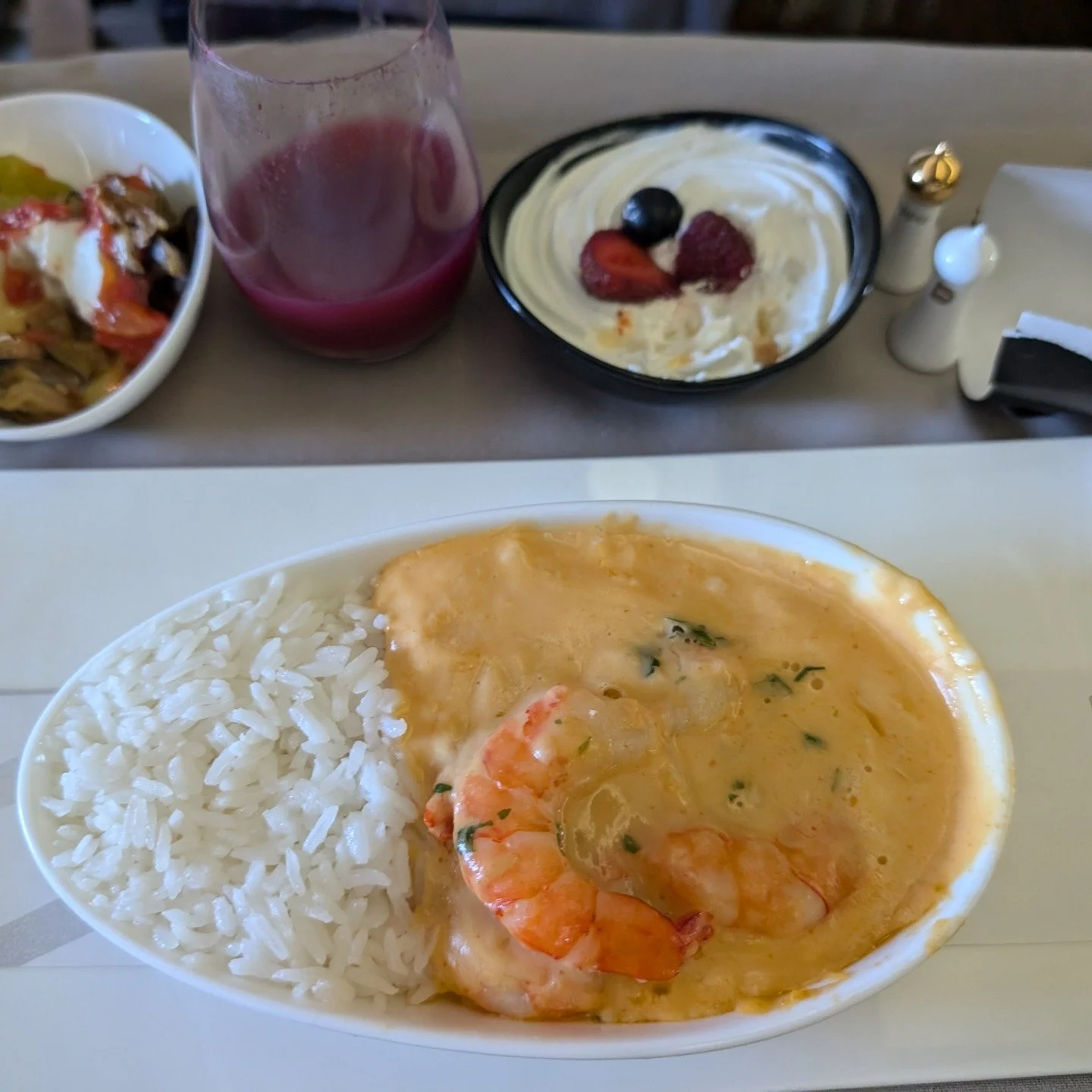
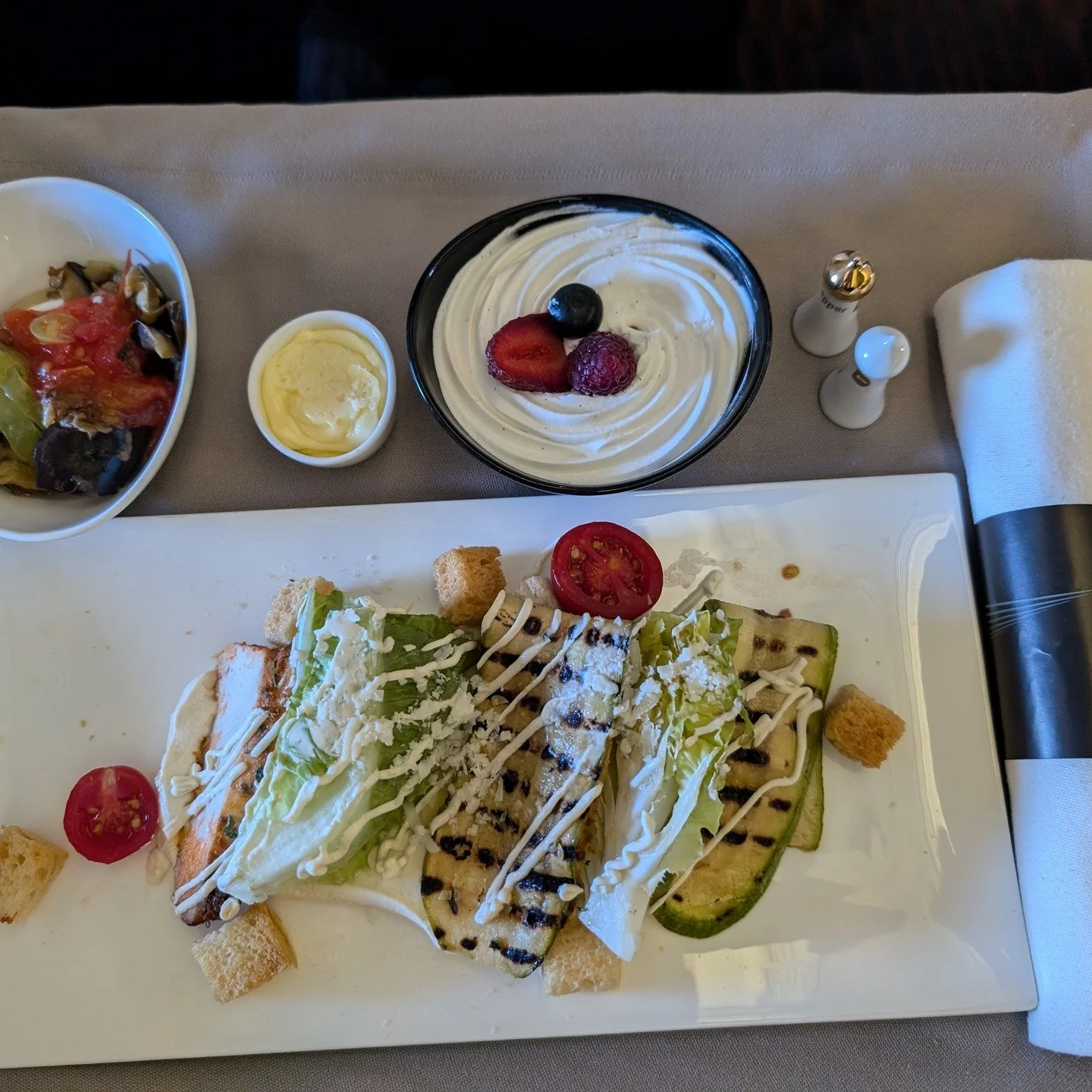
Because it was a long flight (13H, 50M), there were several meals and in-between snacks  served throughout the flight. Some of the items I ate were:

- Smoked Salmon with Sesame with Zucchini Slice

- Cajun Spiced Scallop Topped with Shrimp Roes

- Garden Vegetable Salad

- Grilled USDA Prime Beef Fillet with Garlic and Anchovy Sauce

- Ice Cream

- Coke, Coffee and Tea many times

The food was unparalleled and EVA AIR Business Class was one of the best airlines when it comes to food.

The Washroom

The washrooms were extremely clean, well maintained, and flawless. So far, all my EVA Flight experiences were the same.

Entertainment System

There were fairly recent movies and TV shows, but I didn’t watch anything for long. Eva Air does not provide free Wi-Fi in business.

Final Thoughts

This flight had a night mode feature on the ceiling, like my Toronto to Taipei flight, creating stars in the night sky. When it was dark outside, this feature kept the inside alive by creating space-like environment and I enjoyed it all night.

I have had a few other EVA Air business class flights and they were consistent in terms of excellent service and satisfaction. So far, I have not found any flaws or anything to complain about on any of their flights, and I will be looking forward to experiencing EVA AIR again in the future.