$100 BANK NSF FEE?

Banks are charging too much NSF fees in Canada

Banks Can Charge As Much NSF Fees As They Want

I wrote an article about how banks are charging ridiculous NSF fees. This article became very popular and generated lots of traffic. Recently, after reading this article, one reader wanted to know if there is a maximum allowable NSF fee banks can charge. I could not answer this question because I did not know the answer by myself. So I wanted to find an answer and I ended up calling Financial Consumer Agency of Canada (FCAC).

FCAC is a federal government regulatory agency that ensures financial institutions comply with federal consumer protection laws and regulations. On Thursday I called them to find out if there is limit on how much banks can charge NFS Fee. I was totally blown away by their answers. NSF Fees have no limits. In simple words, In Canada, banks can charge as much NSF fees as they want. What it means? If banks keep increasing NSF fees every year, there is nothing you can do. Remember those days when NFS fees were like $10 or $15? Well, in the future, don’t be surprised if you get hit by $100 NSF fee. It may not happen in a couple of years or so; however; the way banks keep increasing NSF Fees, I would not be surprised if it reaches $100 someday. Right now, NFS fees are still below $50, but this may not last too long. What you can do not to pay NSF fees? Find your answers here: Banks Are Charging Ridiculous NSF Fees

TFSA - No Need To Rush

TFSA or RRSP

First Published: December 10, 2008 ADawnJournal.com

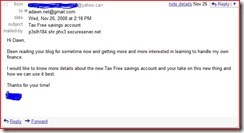
Recently, an ADJ reader sent the following email:

Hi Dawn,
Been reading your blog for some time now and getting more and more interested in learning to handle my own finance.
I would like to know more details about the new Tax Free savings account and your take on this new thing and how we can use it best.
Thanks for your time!

Ms. ADJ Reader (Withholding name for privacy)

Today’s article is specially written for Ms. ADJ Reader and many other ADJ readers who are waiting eagerly to read ADJ article on TFSA.

What Is a Tax Free Savings Account?

TFSA is an account type where you can make contributions, grow your money (means you can earn interest or income), and take out money without paying any taxes.

Doesn’t It Sound Like an RRSP (Registered Retired Savings Plan)?

Kind of. However there are some major differences. Let’s look them one by one.


RRSP

TFSA

When you put money in an RRSP, you get tax slips to reduce your taxable income

contributions in a TFSA do not reduce your taxable income

When you take out money from an RRSP, you pay taxes on withdrawals and your withdrawal will be added to your income (it simply means you taxable income will be higher)

TFSA withdrawals are tax free

RRSP account has age limit (must be terminated by 71);

TFSA has no age limit

Once you put in money, your contribution room is used up. You will not be able to regain your contribution room back by taking out money

Amount withdrawn will create equal contribution room

Some TFSA Features

·   Canadians aged 18 and older can save up to $5000 a year.

·   Annual contribution limit will be indexed and will increase gradually.

·   Contributions will not be tax deductible but income and gains will not be taxed.

·   No taxes to pay when you withdraw money out of TFSA.

·   Income earned or withdrawals will not affect eligibility for Federal benefits such as Old Age Security, Canada Child Tax Credit, Guaranteed Income Supplement.

·   No taxes to pay when you withdraw money out of TFSA.

·   Unused room can be carried forward indefinitely.

·   TFSA account can hold same products like RRSP, such as GICs, stocks, mutual funds, and many more.

·   Upon death, your TFSA can be transferred to your spouse without tax implications.

·   Excess contributions will incur a monthly penalty tax of 1% – just like an RRSP.

TFSA Ideas

You have to be creative here. There are so many ways you can use a TFSA account. Here are some I can think of off the top of my head:

·   If you don’t have room in your RRSP account, use TFSA.

·   If you don’t have room in your RESP account, use TFSA.

·   Use TFSA for short-term savings.

·   Use TFSA for long-term savings.

·   Use TFSA to keep your emergency funds.

My Take

You should use TFSA to its full limits; however, I don’t see there is any need to rush. You will see bank ads and some personal finance blogs making it sound like you should jump into it right now – otherwise, you will miss the boat. This is simply not not the case. TFSA is not going anywhere and there is no need to rush. Take your time to draft your investment planning and strategies and then make full use of TFSA.


Warren Buffett, Cash, Stocks, and Award-Winning Book Invest Now

Warren Buffett, Cash, Stocks, and Award-Winning Book Invest Now

Warren Buffett, the world’s greatest investor, richest man, and dedicated philanthropist, wrote an op-ed post in The New York Times on Oct 16. In this post, Buffett stated that he is getting rid of cash (lots of it) and buying stocks. Buffett’s decision to trash cash and buy stocks amid an ongoing financial crisis has created heavy buzz and it is expected to bring some confidence back in this time of market turmoil. I find Buffett’s article somewhat interesting because what he mentioned in it resembles with what I said in my book, Invest Now. Let me point it out to you by doing a comparison.

What Warren Buffett Said

What I Said In Invest Now

Page No.

“Today people who hold cash equivalents feel comfortable. They shouldn’t. They have opted for a terrible long-term asset, one that pays virtually nothing and is certain to depreciate in value.”

“Stay away from savings accounts. Even if you hold one of those high interest–paying savings accounts, you will not beat inflation in the long run.”

Page 9

“I can’t predict the short-term movements of the stock market. I haven’t the faintest idea as to whether stocks will be higher or lower a month — or a year — from now.”

“Let me give you an eternal stock-market tip that will remain true forever. No one can predict the market. Not I, not you, not any analysts, not Warren Buffett. Simply no one can or ever will.”

Page 83

“What is likely, however, is that the market will move higher, perhaps substantially so, well before either sentiment or the economy turns up. So if you wait for the robins, spring will be over.”

“No one can predict the market, which will always have ups and downs. Focus on your long-term goals. Start investing, keep adding money, and stay invested. If you start early, you will have time on your side; even a smaller amount will turn into a large amount in the long run.”

Page 117

Invest Now is jam-packed with timeless material which is true today, and will remain true forever. In Invest Now, I emphasized staying invested for the long run and asked you not to panic in market turmoil such as what’s happening globally right now. Start investing, focus on your long term goals, and you will survive global financial meltdown.

What Is a FICO® score?

What Is a FICO® score?

The FICO® score is a number (a credit score) between 300-850®. FICO® score is the most widely used credit scoring system in the world. Most of the financial institutions in North America use FICO® score to determine an applicant’s credit risk. Fair Isaac Corporation – the pioneer in credit scoring, developed the FICO® score. Engineer Bill Fair and mathematician Earl founded this corporation in 1965.

A high FICO® score is considered a good score for consumer. Most consumers score in the 600 score and 700 score. Above 700 score mean you are in good financial position and lenders will most likely approve your credit request. Below 600 score indicate you are a high-risk client and lenders will most likely decline your credit request or will approve with much higher interest rates. Lenders buy your FICO® score from credit reporting agencies such as Equifax, TransUnion.

Five Parts

FICO® score is based on the five general categories:

·   Payment History = 35% – Paying bills on time helps. Avoid late  payments.

·   Amounts Owed = 30% – If you owe a lot of money, it lowers your score.

·   Length of Credit history = 15% – A longer history increases your score.

·   New credit = 10% – Too many credit inquiries will lower your score. Lenders consider you a high-risk client when you actively seek credit.

·   Type of Credit = 10% – If you use a combination of different types of credits such as credit cards, mortgage, car loans etc, and have good paying history – it may increase your score.

How To Obtain FICO® score

A regular credit bureau report does not provide FICO® score. For example, regular Equifax Credit Report costs $15.50; however, it will not show your FICO® score. To see you FICO® score, you can purchase Score Power Credit Report – it costs about $24. Or there are free providers such as Mogo, Borrowell, Credit Karma who provide FICO® score for free. Your banks may provide this for free as well. Check your online banking portal.

Are There Any Personal Finance Software Programs That Are Particularly Good For Canadians?

Are You Aware of Any Internet Based Personal Finance programs?

First Published: November 6, 2008 ADawnJournal.com

I always get emails from ADJ readers asking questions on a variety of topics. I try to reply those as soon as I can. Take the email snapshot on the top left, for example. A Canadian couple wants to know which personal finance software programs to use. Today, in this post, I will let you read my answer. I haven’t changed their questions, or my answers, except one thing – their names are being withheld for privacy.

On Tue, Oct 7, 2008 at 11.14 AM, A Canadian Couple XXXXXX@sasktel.net wrote:

Do you recommend any software programs such as Money or Quicken?  Are there any that are particularly good for Canadians? Are you aware of any Internet based personal financial programs?
Thanks.

Here Is My Answer:

Hello There,

Thank you for reading my site. Your questions can be answered in two parts.

Part 1

If you are looking for a software to bring all your accounts such as bank accounts, mutual fund accounts, credit card accounts under one platform, there are two options. You can use either MS Money or Quicken. These two have Canadian versions and you can budget, track your expenses, and see all your accounts and transactions on one screen. Quicken would cost about $100 and MS Money would cost about $50. Many computers have MS Money installed on it. So check first to see if you already have MS Money. Which one is better? Quicken is my choice but it costs more. If you can get free MS Money, do not spend money on Quicken. One point I would like to mention is probably you will get notifications every year asking you to update (meaning spend more money). Do not upgrade. It is unnecessary and a waste.

Part 2

If you do not need to see all your accounts and transactions under one software,  go with an online program.  There are the two I would like to mention: www.Expensr.com and https://www.moneytrackin.com/. I use Expensr. With these you can track your spending, make budgets, set goals etc. Check both and pick the one you like.