What To Do If You Cannot Pay Your Mortgage?

Underpayments, Deliberate and Accidental

Looking at a mortgage agreement – and specifically the payment schedule that is involved in one – is often enough to put even the calmest of individuals into something of a panic. When you stop and think about it, the idea that you are going to pay x amount every month, three hundred times over the course of 25 years seems astonishing. How many of us were doing the same thing twenty-five years ago that we are today? Some of us were not even born. And by the time twenty five years are up, what age will we be? Can we realistically imagine that for the next twenty five years we will be doing the same thing, living in the same place, paying to the same mortgage?

Of course, in many cases we will not be paying the same mortgage. Many individuals and families move house semi-regularly for work reasons, to emigrate or to be closer to extended family. Whatever the reason for moving, this generally results in selling up the current home, paying off the mortgage on it in full, and taking out a new mortgage on a new home elsewhere. For those of us who stick with the same house and the 300-month plan, however, the situation can certainly seem quite daunting. How, one asks oneself, can I possibly keep to an arrangement that goes on for so long? This is why mortgage payments are calculated to generally be set at a level which the customer can comfortably manage. Even if they have a few months of financial stricture, normally savings or help from one’s family can keep things ticking over.

For some people, however, it becomes a case of simply not being able to maintain the payments in the short term. Families will help up to a point, but cash and goodwill are only ever in plentiful supply when they do not have to be frequently relied upon. In such cases, it is often possible to make an underpayment to your mortgage – at least as long as you tell your lender that you are going to do it. Getting in contact with your mortgage lender when it appears more likely than not that you will be unable to meet the agreed monthly payment means that they can put arrangements in place to collect the reduced monthly amount. For a period of a few months, this can make a big difference.

Underpaying a mortgage payment either accidentally or carelessly without regard for the consequences, however, brings different challenges to the table. In the case of an non-agreed underpayment, you will incur a fee on the mortgage which will increase the balance and make for a tougher time paying things off. It will also adversely affect your credit score and lead to the lender treating you less sympathetically. If you cannot make the payment to your mortgage, then let your lender know. If you can, then make the payment – your home is a priority, and keeping up payments on it a necessity.

Where Are We In Terms Of The Global Financial Situation?

Happy Birthday, Global Financial Crisis

First Published: ADawnJournal.com September 24, 2009

There has been so much said over the past couple of years about the dangers of recession, and much still to be said, but one event seen by many as the moment that the global financial crisis became a fact was the collapse of the American investment bank Lehman Brothers. It was one year ago this week that the bank went bust, and the realities of the crisis became clear to everyone at that point. If the Global Financial Crisis has a birthday, that date is the 16th of September. One year on, where are we in terms of the global financial situation?

The collapse of Lehman Brothers marked the point where governments around the world decided that intervention was the way to go. From that point on, many banks have been effectively nationalised – an act which in itself was massively controversial, seeing diverse reactions in different countries. In America, for example, Barack Obama’s determination to bolster the banking sector and revive the world’s largest economy led to accusations of totalitarianism, communism and Nazism. It may sound amusing, but this reaction was, seemingly, entirely serious. In other nations, a sense of skepticism over bank bailouts also persisted, but the bailouts are ratified now and the recovery is in place.

Would the world’s economy have bounced back in such a way and so soon without the government interventions that took place in most of the larger economies? It seems unlikely. Certainly, the banks which have received bailout cash have posted mixed results, with Goldman Sachs posting record numbers very shortly after receiving their lifeline, while others have suffered record losses. But many independent sources feel that the recession is in its last blasts and that this is due in no small part to government intervention. No government has given any indication that further bailout cash will be released, however, so it is now very much a matter of waiting for the situation to stabilise.

While we wait for that, it is believed that the recession has yet to do the last of its work in the sphere of employment. A recent report from the OECD claims that as many as 15million people worldwide have lost their jobs as a result of the financial crisis, and that there could yet be another 10million people made unemployed. Although economic results are improving, the effects of the recession will still be felt for a while to come.

While it would be fair to say that the financial sector has always had its critics, the overwhelming thread running through public reaction to the situation has been one of severe distrust of banks and bankers, and of injustice at the bailouts given to banks while many other industries have been left to fend for themselves. There is still a reluctance on the part of the banks to lend to customers – much to the chagrin of the governments which released the cash to save them – and it might be a while before the stability being claimed for the global economy is seen in the bank accounts and employment prospects of the “man on the street”. This story has some time to run as it blows out the solitary candle on its birthday cake.

Scam Alert - Beware of This Canada Revenue Agency Letter

Sample CRA scams

Scam Alert - Beware of This Canada Revenue Agency Letter

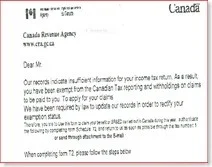
Canada Revenue Agency recently issued a warning asking taxpayers to beware of a scam letter asking Canadians for personal information. CRA has not sent any such letters asking for any personal information whatsoever. Be extremely careful when you receive this type of mail. Feel free to view the attached picture of this scam letter.

This letter claims that there is "insufficient information" for your tax return and you have to update your records to receive any claims. It does not stop here. There is an attached form asking to fax or email your personal information. This letter is not from CRA. You should be vigilant when anyone (even CRA) asking you to release personal information. If you ever receive any such letters asking personal information, call the institution to verify first. Visit CRA Web site for more info.

If you ever believe you have been a victim or someone has tried to scam you, here is what you can do:

- Call your local RCMP detachment or your Police Department

- Report your situation online through Reporting Economic Crime Online

- Visit PhoneBusters, send an email to info@phonebusters.com, or call 1-888-495-8501

Remember, common sense and vigilance are your best defence.

Qantas International Business Class Review | Auckland – Sydney | Boeing 737-800 (winglets)

New Zealand Travel Blog: Part 17 | QANTAS Business Class | Boeing 737 - 800

Business Class | Boeing 737 - 800

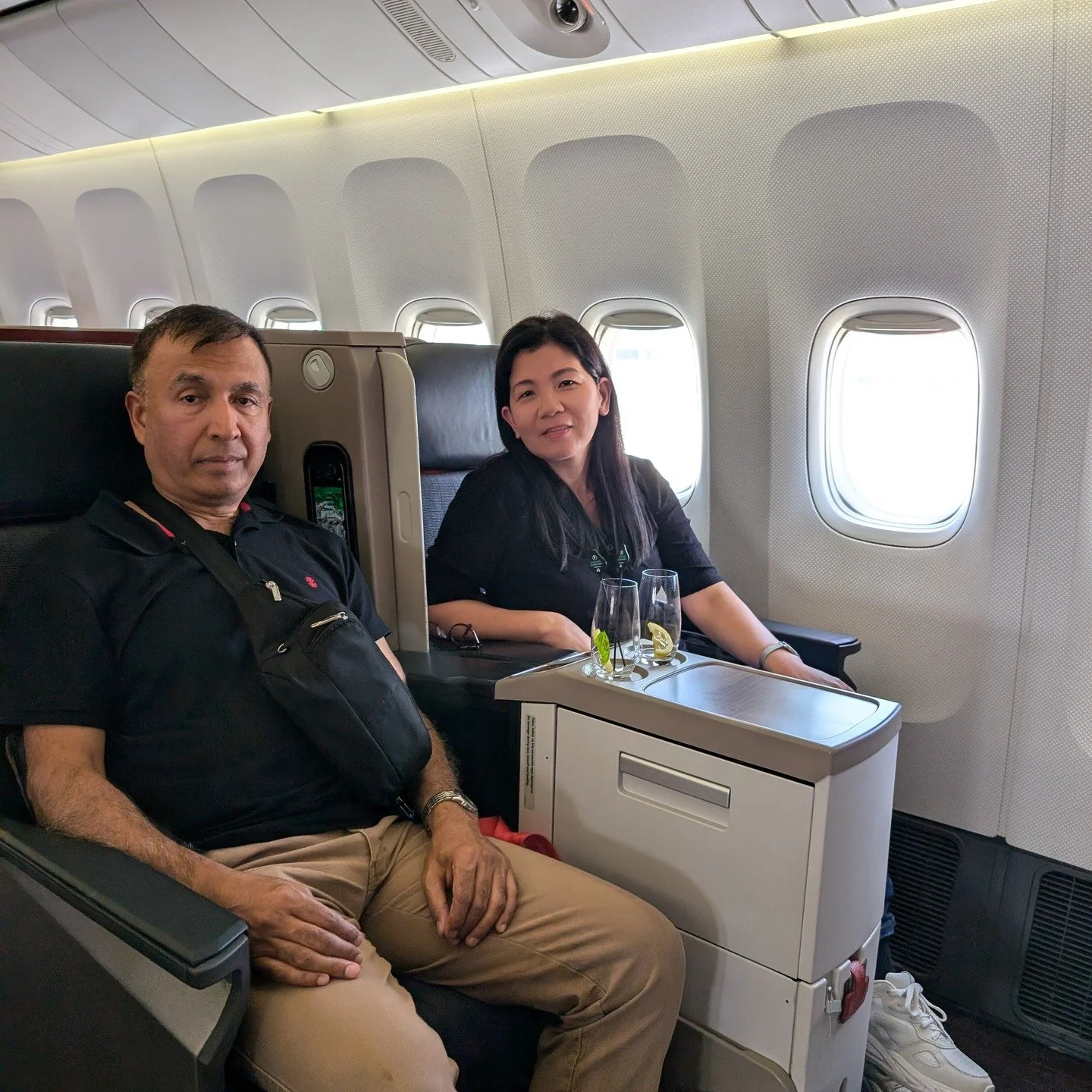
Like my Business Class flight from Melbourne to Auckland, I was expecting a business class cabin suite like in the Airbus A330 - 200, but I was disappointed. Qantas 737 - 800 Business Class seats are just upgraded versions of economy class.

These are not lie-flat seats. Laid out in a 2-2 configuration, Qantas 737 - 800 seats are recliner seats wrapped in maroon leather which offers 37 inches pitch and 22 inches width. There is no direct aisle access for window-side passengers. 

 Seats have an adjustable headrest and there is a 10.6-inch entertainment screen in the back of the seat. The problem with this is if the front person reclines, your monitor reclines too. For 7 inches more legroom and 5 inches more width, if I were paying for this flight, I would not upgrade from economy. 

The food, however, I couldn’t complain about. I had a sourdough sandwich with roast beef, cheddar cheese, tomato, and baby spinach. I also had coffee, ice cream and orange juice.

 The washrooms were OK, but I have had better ones in other business class flights. Another thing I noticed was that the aisle was narrow, so it was not easy to walk to the washroom if you bump into another person.

Overall, my experience with Qantas 737 - 800 was average. I was missing my Melbourne – Auckland Airbus A330 – 200 trip the whole time.

 I was scheduled to reach Sydney at 8:05 PM and planned to take the subway to reach my hotel in downtown Sydney. It would probably be midnight by the time I got there and I was excited about the experience of taking the subway in Sydney for the first time.